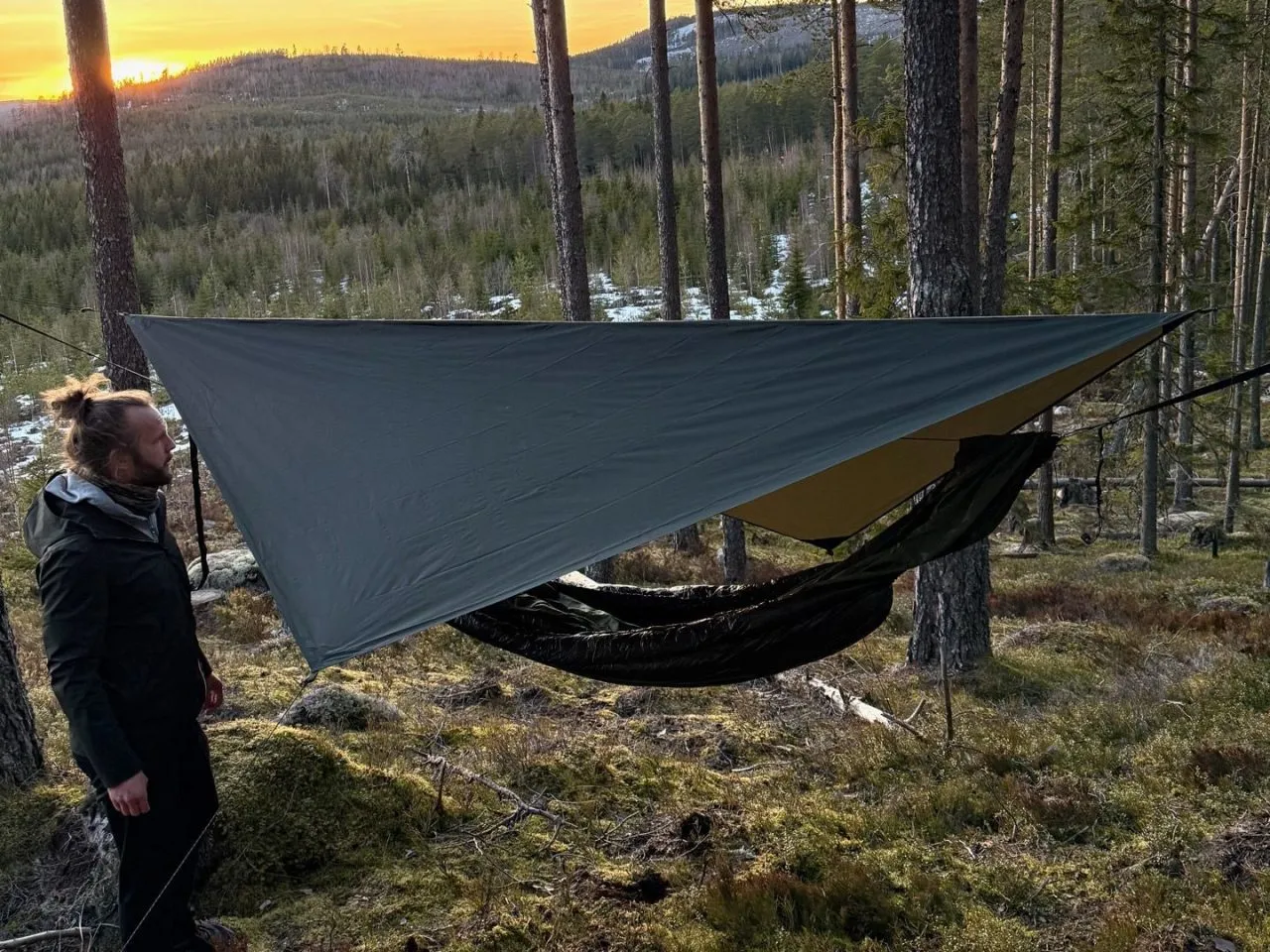
An underquilt is the single most important accessory for anyone sleeping in a hammock – and yet it is the piece of kit most beginners skip. The result? A freezing night and a solemn vow never to sleep outside again.
It doesn’t have to be that way. This guide explains everything you need to know about underquilts: what they do, how they work, and how to choose the right one.
What is an underquilt?
An underquilt is an insulated quilt that hangs underneath your hammock. It creates a protective layer between you and the cold air below.
But wait – why not just use your sleeping bag? Good question. The problem is physics: your body weight compresses the sleeping bag’s fill underneath you. Compressed material doesn’t insulate. It’s like lying on a flattened jacket – it no longer keeps you warm.
An underquilt hangs freely beneath the hammock and is never compressed by your weight. The fill keeps its loft – and it is the loft that creates insulation.
How does an underquilt work?
The principle is simple: still air insulates. An underquilt creates a thick layer of trapped air between you and the cold outside air. The more loft (fluffiness), the more air is trapped, and the warmer you sleep.
Without insulation beneath you, you face two enemies:
- Convection – cold air circulates under the hammock and carries away your body heat.
- Conduction – the thin hammock fabric conducts heat directly from your body into the cold air.
An underquilt stops both. The fill traps air in thousands of tiny pockets and forms a barrier that keeps your warmth where it belongs.
Down vs synthetic – which fill should you choose?
The two most common fill materials are down and synthetic. Both have their strengths.
Down (like the Momo Jord Underquilt)
- Best warmth per gram – down gives the most warmth per gram. A down underquilt weighs considerably less than a synthetic one with the same temperature rating.
- Packs down tiny – down compresses to a fraction of its size and springs back to full loft.
- Long lifespan – quality down (such as 850 fill power) lasts 10-20 years with proper care.
- Sensitive to moisture – wet down insulates poorly. But with a tarp overhead it is rarely a problem in practice.
The Momo Jord Idun Underquilt (UQ300-UQ800) uses 850 fill power RDS-certified down – that means premium down to an ethical standard, where the geese have not been subjected to live-plucking or force-feeding.
Synthetic
- Works when wet – synthetic keeps some of its insulating power even when damp.
- Cheaper – synthetic underquilts often cost half as much.
- Heavier and bulkier – you pay the price difference in weight and pack size.
- Shorter lifespan – synthetic loses loft faster, especially the cheap versions that clump up after a few seasons.
Our recommendation: for serious hammock camping, go with down. You carry your kit on your back – every gram counts. With a good tarp overhead, you don’t need to worry about moisture.
Temperature ratings – which underquilt for which temperature?
Underquilts are sorted by temperature. Two terms to know:
- Comfort rating – the temperature at which an average person sleeps comfortably.
- Limit rating – the temperature at which you’ll survive the night, but may not sleep well.
Always go by the comfort rating, not the limit. Lying awake shivering all night isn’t adventure – it’s bad planning.
Want to understand exactly what those temperature numbers really mean, and why a rating on the label isn’t a promise? Read our deeper guide, Underquilt Temperature Ratings: What They Really Mean.
Momo Jord Underquilt – four versions for every season
| Model | Fill | Weight (total) | Guide rating* | Best for |
|---|---|---|---|---|
| UQ300 (Summer) | 300 g 850FP down | approx. 600 g | +5°C and warmer | Summer, warm nights |
| UQ400 (Late summer) | 400 g 850FP down | approx. 700 g | down to 0°C | Late summer, cool nights |
| UQ500 (Spring & late autumn) | 500 g 850FP down | approx. 800 g | down to −5°C | Spring, autumn, 3-season |
| UQ800 (Winter) | 800 g 850FP down | approx. 1100 g | down to approx. −10°C (customer-tested) | Winter, real cold |
All four measure 208×142 cm – generously cut to eliminate cold bridges along the edges. Made from 10D ripstop nylon for low weight and a small packed size; the fabric is protected by the tarp overhead.
*Guide ratings, not lab-tested EN figures. Temperature tolerance is individual – weather, clothing and your topquilt all play a part. Customers have slept warm down to around −10°C in the UQ800.
Not sure? The UQ500 (Spring & late autumn) is a safe all-rounder that covers most of the year across Scandinavia and works brilliantly paired with a topquilt or sleeping bag.
How do you choose the right underquilt?
Five things to check:
- Length – the underquilt has to cover you from shoulders to feet, with margin. 208 cm is enough for the vast majority. A too-short underquilt creates cold spots at the feet – the most common complaint among beginners.
- Fill amount and fill power – more fill = more loft = more warmth. 850 fill power is premium. Cheaper quilts use 600-700 FP, which needs more fill for the same warmth (= heavier).
- Temperature rating – be honest about the temperatures you’ll actually sleep in. Better not to freeze on your first night.
- Fabric – thin ripstop nylon keeps the weight down. The Momo Jord Underquilt uses 10D for the lowest weight and pack size, protected by the tarp overhead. If you want a tougher weave, 20D exists, but you pay for it in weight.
- Suspension system – good carabiners and shock cord make setup quick and easy. Cheap systems with knots and cords take time and frustrate.
Setting it up, step by step
The Momo Jord Underquilt uses a 4-point suspension system with shock cord and carabiners. Here’s how:
- Hang the hammock first – make sure it hangs at the right height and angle (30-degree angle on the suspension straps, lowest point at sitting-bench height).
- Clip in the end carabiners – hook the underquilt’s two end points onto the hammock’s suspension points or straps. Head end and foot end.
- Adjust the sides – pull the shock cord along the sides until the underquilt sits flush against the underside of the hammock with no gaps. You want contact – an air gap between quilt and hammock means lost insulation.
- Fine-tune – sit in the hammock and feel for cold spots. If there are any, adjust. The quilt should follow your body without being squashed.
See the whole process on video: How to set up your Momo Jord Underquilt
7 common underquilt mistakes
- Underquilt too short – buy a 170 cm quilt for a 210 cm hammock and your feet will freeze. Every time.
- Gap between quilt and hammock – that creates a cold draught. The underquilt should sit flush. Adjust the shock cord.
- Under-rated insulation – a summer quilt in October is a cold story. Always choose with margin.
- Cheap synthetic that clumps – low-quality synthetic fill loses its loft after a few uses. Suddenly you’re freezing even though the quilt used to work.
- No tarp – morning dew, unexpected rain or frost can ruin down’s insulating power. A tarp is mandatory.
- Pulling the quilt too tight – over-tensioning the shock cord compresses the fill. Just-right tension – the quilt should stay fluffy.
- Skipping the underquilt entirely – “it’s only September, it’ll be fine” – no, it won’t. You’ll feel the cold from below in a hammock as early as +10°C.
Frequently asked questions about underquilts
Can I use a regular sleeping pad instead?
Technically yes, but it works poorly in a hammock. The pad slides around, creates gaps and gives uneven insulation. An underquilt wraps the underside of the hammock completely and gives consistent insulation without you having to think about it. A sleeping pad works as an emergency backup, not as your primary insulation.
How do I wash my down underquilt?
Wash it rarely – air it out after every trip instead. When it’s needed: hand wash in lukewarm water with a down-specific detergent (Nikwax Down Wash or similar). Tumble dry on low heat with tennis balls. Never dry clean.
Do all underquilts fit all hammocks?
In principle yes, but size matters. The Momo Jord Underquilt (208×142 cm) works with any hammock 280 cm or longer. The extra width (142 cm) gives good coverage even when you lie diagonally.
Do I need an underquilt in summer?
In the Nordics: usually not in June and July if nights stay above 15°C. But by August nights can dip below 10°C, especially in the far north or near water. The UQ300 (Summer, 300g) weighs almost nothing and is cheap insurance.
How long does a down underquilt last?
With proper care: 10-20 years. 850 fill power down (as in the Momo Jord Underquilt) holds its loft longer than lower grades. Store it uncompressed in a large storage bag – not in the compression sack.
Can I use the underquilt in a tent?
Absolutely. Hang it under a cot or lay it beneath your sleeping pad. It works, but the underquilt is designed and optimised for hammocks.
Ready to upgrade your hammock experience? See the Momo Jord Underquilt – 850FP RDS down, 208×142 cm, four temperature ratings. Free shipping over €99.