Hammock advice often turns a useful starting point into a universal law. Bodies, hammock designs, fabrics, suspension systems and campsites differ. The answers below separate measurements from setup guidance and explain what to adjust when a recommendation does not suit you.
1. Must you lie diagonally?
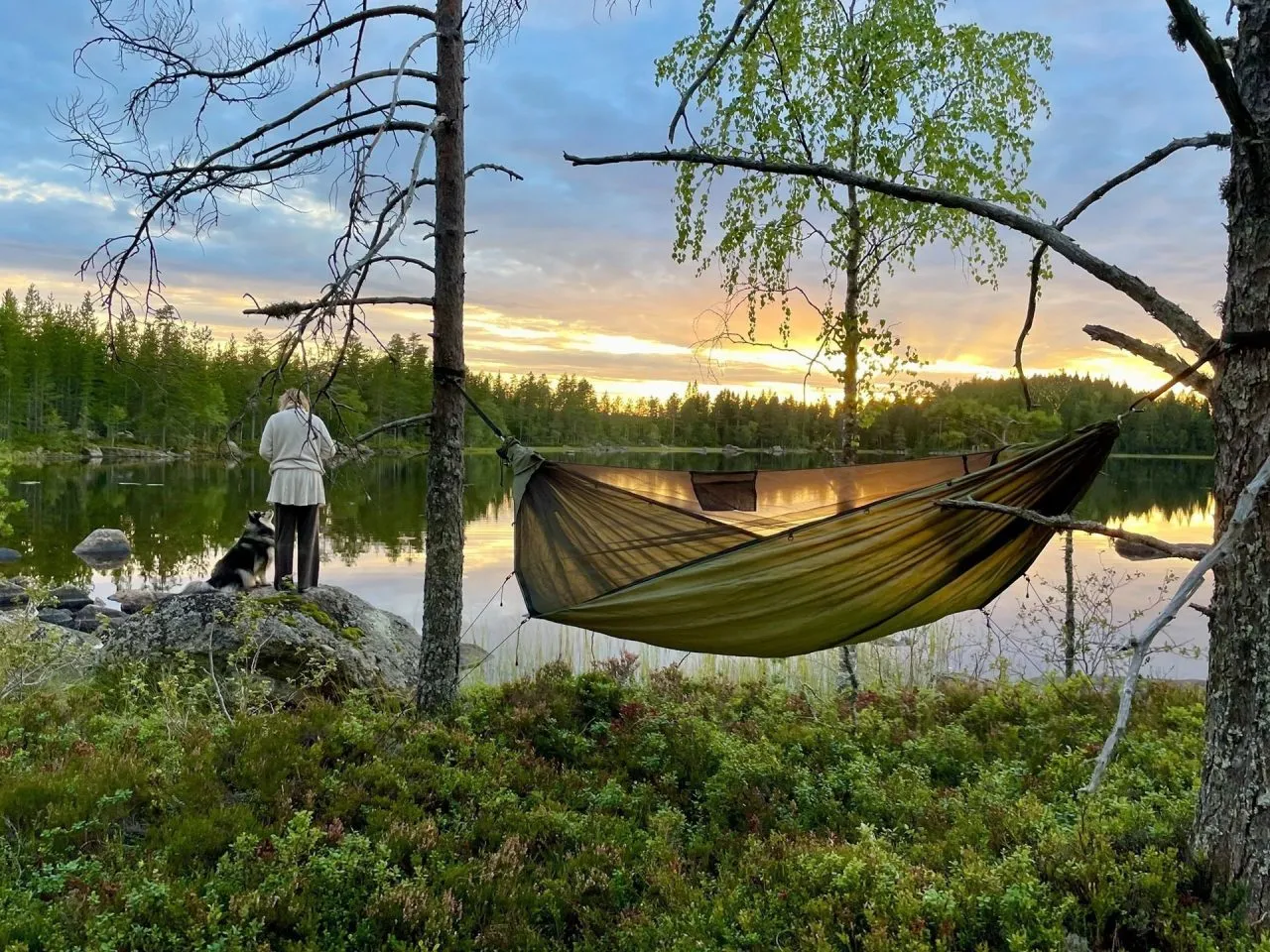
In a gathered-end hammock, a diagonal position often reduces the curve felt along the body. The Momo Jord hammock is asymmetrically shaped for that purpose. Hennessy Hammock’s own design documentation likewise describes diagonal use for its asymmetrical models. That supports the technique, not a guarantee that one exact angle is best for every person.
Begin with head and feet on opposite sides of the centreline. Move only a little at a time. If shoulder pressure or a tight ridge under the legs increases, return toward the centre and try a smaller diagonal.
2. Is 30° the correct suspension angle?
About 30° is a useful starting point for many gathered-end hammocks. Warbonnet gives roughly 30° in its official Hammocks 101 setup advice. It is not a certification for every hammock or site.
The important mechanical point is direction: as the suspension becomes shallower and more horizontal, tension rises. Our hang-force calculator uses the static relationship T = W/(2·sin θ) to illustrate that change. Real anchors also see movement, uneven loading and equipment-specific forces, so the calculator is educational rather than a hardware rating.
Do not pull the hammock guitar-string tight. Keep the seat low enough for a controlled entry, use suitable trees and stay within the hammock and suspension manufacturers’ limits.
3. Does a ridgeline have to be exactly 83%?
No universal percentage is required. A structural ridgeline mainly makes sag more repeatable when tree spacing changes. Hennessy describes that repeatability as the purpose of its integrated ridgeline. A percentage commonly used for adjustable gathered-end hammocks can be a starting point, but it is not derived from the 30° force equation and should not be presented as exact physics.
The Momo Jord hammock includes its ridgeline as part of the design. Use it as supplied. If you use a hammock with an adjustable ridgeline, follow its manufacturer’s instructions and change length in small increments. A line that is extremely tight under load is a sign to review the setup, not to force the hammock tighter.
4. What causes calf pressure or knee discomfort?
A firm ridge under one leg is a symptom, not a diagnosis with one universal fix. It can change with sag, diagonal position, body position and how the fabric is loaded. Try one adjustment at a time: reduce or change the diagonal, alter the suspension slightly within the manufacturer’s guidance, and move the feet or knees. A small pillow or folded garment under the knees can also be a comfort experiment.
Stop using the setup if you experience persistent pain, numbness or circulation symptoms. Equipment advice is not medical assessment.
5. Underquilt or sleeping pad?
Insulation compressed beneath the body contributes less warmth. An underquilt avoids body compression by hanging outside the hammock. A sleeping pad resists compression through its own structure. Both can provide bottom insulation.
An underquilt usually conforms around a gathered-end hammock but must be adjusted to avoid gaps or compression. A pad is useful when the same item must also work on the ground, but its width, shape and surface affect stability and shoulder coverage. Neither option is automatically correct for every user or temperature. Use the product’s stated guidance, the forecast and a prudent margin.
6. Is a double-layer hammock stronger or warmer?
Only the manufacturer’s rating can answer the strength question for a specific hammock. Two fabric layers do not justify calculating your own load increase: fabric type, seams, gathered ends and suspension all matter.
Some double-layer designs create a pocket that helps keep a pad in position. Whether a particular pad fits is product-specific. An extra fabric layer alone is not a substitute for insulation with a known thermal performance.
7. Is differential cut mandatory in an underquilt?
A differential cut gives the inner and outer shells different dimensions so insulation has room when the quilt curves. It can help a down underquilt retain loft, but the finished baffle design, suspension and fit determine the actual result. “Differential cut” on a feature list is not a temperature guarantee.
Judge the setup while the hammock is occupied: the quilt should follow the body area it is meant to cover, without open channels or visibly flattened insulation.
8. Down or synthetic insulation?
Down generally offers low packed volume for its warmth, while continuous-sheet synthetic insulation can retain useful structure when damp and is often less expensive. The exact comparison depends on fill quality, construction and model; simple claims such as a universal weight ratio or fixed lifespan are not dependable.
Choose according to the actual product data, trip length, opportunities to dry equipment, pack-volume priorities and care. Keep either type protected from rain and dry it according to the manufacturer’s instructions before storage.
9. Which suspension system is best?
The useful comparison is not “best” but whether the complete system is rated, inspectable, adjustable enough for the site and protective of trees. The Momo Jord hammock includes 2.8 m daisy-chain straps with ten loops and carabiners. Other hammocks may use buckles or adjustable cord systems and require different procedures.
Use broad tree straps, inspect webbing, stitching and connectors, and follow local rules. Do not attach thin cord directly around bark. Retire components that are cut, heavily abraded, deformed or otherwise outside the manufacturer’s guidance.
10. How much tarp coverage is enough?
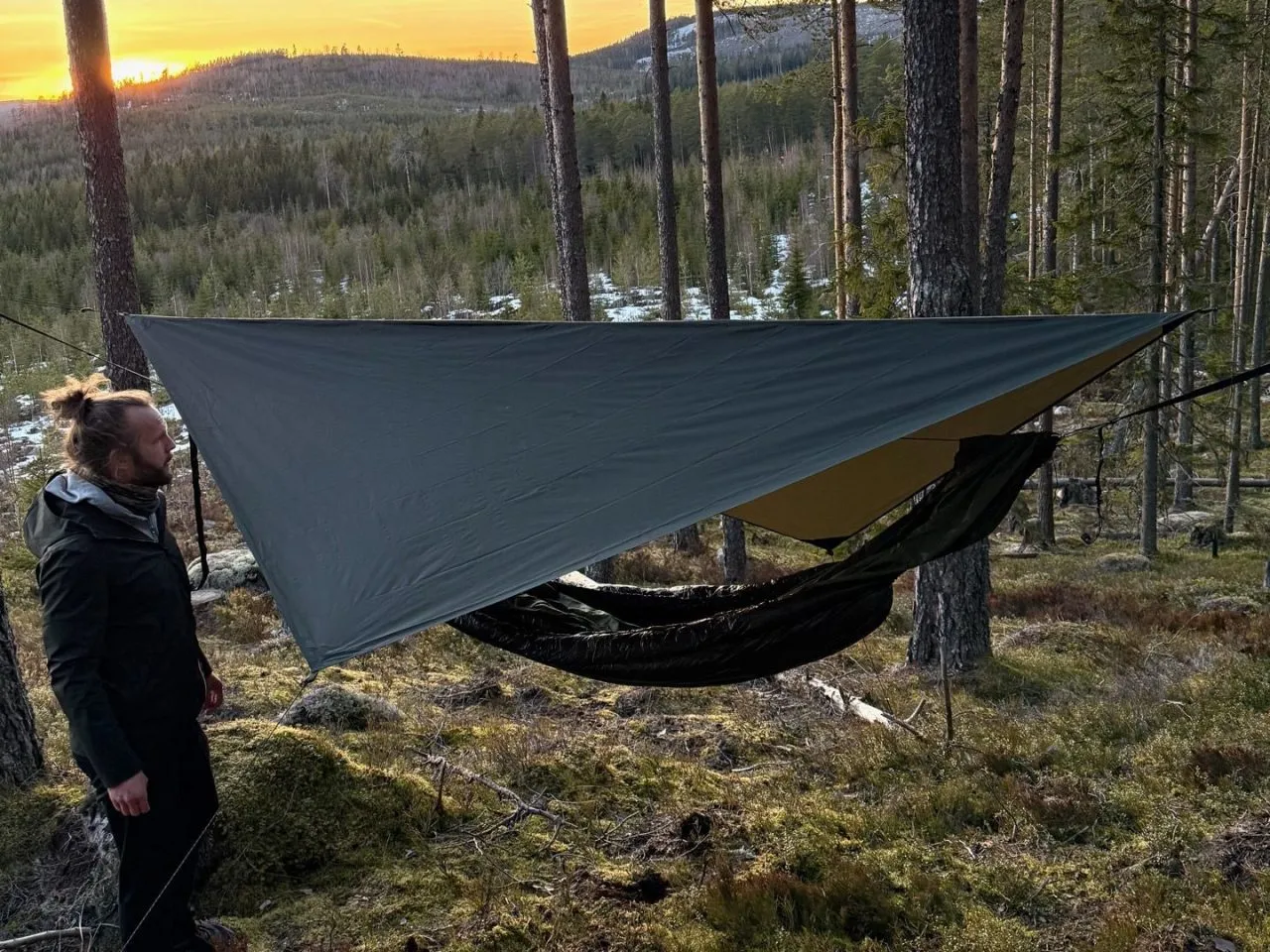
There is no single overhang number that covers every tarp shape, hammock, pitch and wind direction. The current Momo Jord asymmetrical tarp measures 360 cm along the ridgeline and 310 cm corner to corner and is designed to match the diagonal Momo Jord setup. More enclosed tarps trade extra coverage for weight, bulk and ventilation.
Choose for the real forecast and site. Practice the intended pitch, orient the protected side toward incoming weather and use a more conservative shelter when wind-driven rain, snow or uncertain conditions demand it.
Primary sources and current product data
- Warbonnet Outdoors: Hammocks 101 – manufacturer setup guidance, including the approximate 30° starting point.
- Hennessy Hammock: design documentation – manufacturer explanation of diagonal lay and structural ridgeline.
- Momo Jord Hammock, Underquilt, Asym Tarp and hang-force calculator – current specifications and Momo Jord setup model.
Manufacturer documents, product data and links checked on 12 August 2026.