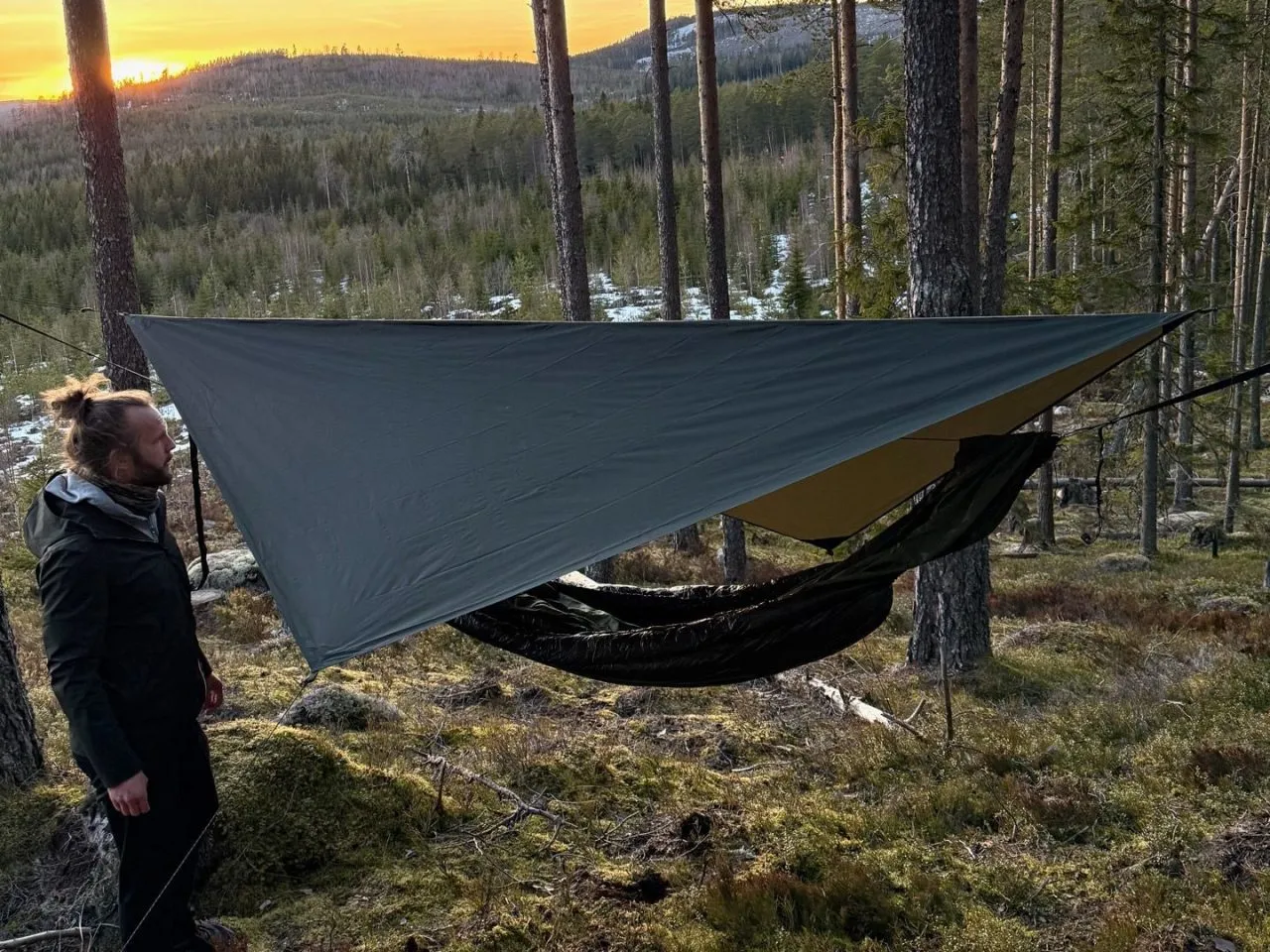
The best hammock tarp is the one that covers your sleeping position without weighing more than it has to. For pure hammock camping in the woods, a light asymmetric tarp around 350–500 g does the job. If you want a roof that can also pitch as a ground tent or group shelter, go square instead and carry the extra weight. Momo Jord’s Asym Tarp weighs 350 g and costs €79. DD’s classic 3×3 weighs 790 g and costs around €68 through a European retailer, VAT already included — order it straight from the UK instead and you’re looking at import charges on top of the sticker price.
I spent fifteen years selling other people’s tarps before I drew my own, and roughly as long pitching them in Hälsingland rain — often in the dark, sometimes with a thunderhead rolling in. A tarp is the one piece of kit in the whole system you never notice when it’s good. You only notice it when it’s bad: the puddle creeping in at the foot end, the corner that flaps loose at three in the morning, the “silnylon” that turned out to be a builder’s tarpaulin in disguise. So this is less about whose product photo looks best and more about what actually keeps the water out when it matters.
The tarp is the roof — nothing else
First bit of housekeeping: the bug net lives on the hammock, not the tarp. If you’re searching “tarp with mosquito net,” what you actually want is a hammock plus a tarp — two pieces of kit, two jobs. On our hammock the net is already sewn in, so the tarp — your rain cover over the hammock — only has to worry about rain, and the net only has to worry about mosquitoes. The full package — hammock, suspension, net and tarp together — is what people usually call a hammock tent.
Shape: asymmetric or square
Shape decides more than brand does. There are, in practice, two routes for a hammock.
Asymmetric tarp. Cut on the diagonal, following the position you actually lie in. That gives the least fabric weight for full coverage over the hammock itself — but only over the hammock. No margin to duck out under, no floor, no second use. Momo Jord’s Asym Tarp is the only dedicated asymmetric tarp in this comparison, and the lightest for it.
Square tarp, diamond pitch. A 3×3 m tarp pitched corner-to-corner along the ridgeline gives a ridge of just over four metres and fabric walls reaching well down the sides. More coverage, better in wind-driven rain, and it doubles as a ground tent or group shelter when you’re not hanging. The price is weight and pack size. All three square tarps in the table below — DD, Fjällräven, Moon Tarp — belong to this camp.
(Looking for a “Fjällräven Endurance tarp”? You won’t find one. Endurance is a tent-fabric line at Fjällräven, not a tarp. What you actually want is the Abisko Tarp.)
How big a tarp do you actually need?
The ridgeline should run a little longer than your hammock. Ours is 350 cm, and the Asym Tarp’s 360 cm ridge covers it with margin. A square 3×3 pitched diamond-style gives roughly 4.2 metres along the ridge — generous, which is exactly what you want when rain comes in sideways. None of these tarps ship with a ridgeline of their own: you rig that yourself with a thin 3 mm line between two trees. The Asym Tarp comes with stakes, guy lines and two carabiners to clip onto that line; the line itself is on you.
Silnylon or PU — and what denier actually means
Two words show up on every spec sheet. Denier (D) describes the thickness of the thread: 20D is ultralight, 40D tougher and heavier; “190T” is thread count for polyester rather than denier, but in practice lands in the heavier, cheaper end of the scale. Silicone versus PU is about the coating: silicone-coated nylon (sil) is lighter, stronger and pricier; PU-coated fabric is cheaper, heavier and easy to seam-tape. Hydrostatic head is measured in millimetres — 3000 mm is comfortably enough for Northern European rain, and it’s where most serious tarps sit (one in this comparison sits lower — more on that below). PFAS-free coating is worth checking; Fjällräven and Momo Jord are both PFAS-free, which far from every tarp on this list can say.
| Momo Jord Asym Tarp | DD Tarp 3×3 | DD SuperLight | Fjällräven Abisko | Moon Tarp | |
|---|---|---|---|---|---|
| Price (approx.) | €79 | ~€68 via EU retailer (~€49 direct, UK) | ~€115 via EU retailer (~€90 direct, UK) | ~€205 | ~€90 |
| Weight | 350 g (455 g complete) | 790 g | 490 g | 500 g | 775–845 g |
| Size | 360 × 310 cm | 300 × 300 cm | 300 × 290 cm | 300 × 300 cm | 250 × 250 cm |
| Shape | Asymmetric | Square | Square | Square | Square (small) |
| Material | 20D silicone-coated ripstop, 3000 mm, PFAS-free | 190T PU-polyester, 3000 mm | Ripstop nylon PU, 3000 mm | 40D silnylon, 3000 mm, PFAS-free | 70D PU-nylon/polyester, 2000 mm |
| Where to buy | momojord.com — in stock, EUR | UK direct, or European retailers | UK direct, or European retailers | European retailers | Ticket to the Moon’s EU store |
Prices and specs checked July 2026 with each manufacturer. Where a brand doesn’t sell directly in euros, we’ve converted at that week’s rate and rounded — competitor prices move, so don’t hold us to the exact cent.
The tarps, one by one
Momo Jord Asym Tarp — €79, in stock
Ours, so take the praise with a pinch of salt — but the numbers stand on their own. 350 g for the tarp alone, 455 g with stakes, lines and carabiners in the bag. 20D silicone-coated ripstop, 3000 mm hydrostatic head, PFAS-free, in a muted olive. The asymmetric cut gives you an open view to one side and the least possible fabric against the rain. Where I’ll be straight with you: it’s built for woodland pitches, not storms. If you’re heading out onto open, wind-scoured high ground, a low-pitched square tarp is the safer call — the Asym Tarp is happiest among trees, in shelter, in ordinary, persistent rain. We also make a bigger square tarp (350 × 300 cm) for harder Nordic weather, but it’s out of stock right now, so the lightweight Asym Tarp is the one I’m pointing you to today. It’s also part of the Hammock Kit bundle — hammock, suspension, tarp and underquilt from €159 — if you’d rather buy the whole system in one go.
DD Tarp 3×3 — the value pick
Europe’s best-selling hammock tarp, and for good reason. Around €68 through a European retailer, VAT included — still cheaper than my own. 300 × 300 cm, 190T PU-polyester with a 3000 mm head and a taped ridge seam, and — the reason people love it — 19 attachment points. Nineteen. You can pitch it a dozen ways, cinch it down for storms, set it up as a ground tent. The catch is weight: 790 g, more than double the Asym Tarp, and PU-polyester packs bulky. Order it straight from ddhammocks.com in the UK instead, and post-Brexit, that parcel is an import into the EU — expect import VAT on top of DD’s own roughly €49 list price. Either way, as a first tarp, or the do-everything one in the cupboard, it’s hard to argue with.
DD SuperLight Tarp — DD for the gram-counter
Same DD logic, half the weight. 490 g, 300 × 290 cm, the same 19 attachment points, ripstop nylon with a PU coating and a 3000 mm head. Packs down to roughly half the volume of the 3×3. You pay for it — around €115 through a European retailer (about €90 on DD’s own UK price list, before import VAT) — for nearly the same coverage as its bigger sibling at 300 g less. For anyone who wants DD’s versatility without DD’s bulk, this is the sensible middle ground. (DD doesn’t publish an exact denier for this one, so I’m leaving that figure out rather than guessing.)
Fjällräven Abisko Tarp — the premium fabric
If anyone beats me on material, it’s this one. 40D TripleRip silnylon, sil/sil-coated, 3000 mm, PFAS-free, with reflective 2 mm Dyneema guy lines and sewn seams — and still only 500 g at 300 × 300 cm. Well built, and it holds its resale value. Two honest objections: it costs around €205, just over two and a half times the Asym Tarp, and it has fourteen attachment loops against DD’s nineteen — somewhat fewer pitching options, even though six reinforced Dyneema guy lines come in the box. It isn’t a dedicated hammock tarp — it’s an excellent all-round tarp that also happens to work over a hammock. If you want the best weave on the market and the price doesn’t bother you, this is it. Widely stocked across Europe.
Moon Tarp (Ticket to the Moon) — the purpose-built roof
Ticket to the Moon’s tarp, built specifically as a hammock roof and backed by a ten-year warranty, which is unusually generous. Around €90 through Ticket to the Moon’s own EU store, 775–845 g, 250 × 250 cm, 70D PU-nylon/polyester. The honest catches: at a 2000 mm hydrostatic head it’s rated lower than everything else in this table (the rest sit at 3000 mm), and at 250 × 250 cm it’s still the smallest tarp here, so there’s less margin when rain comes in at an angle. It’s also pricier than the DD 3×3 for less coverage. One more thing: Ticket to the Moon revised this tarp — older stock at some retailers is the lighter 660 g / 247 × 247 cm / 3000 mm version, and the two aren’t the same tarp, so check the spec sheet before you buy. Best suited to anyone who already has a Ticket to the Moon hammock and wants a matching roof.
A plain ground tarp or builder’s tarpaulin?
A cheap square PU tarp keeps the rain out. But it’s heavier, bulkier, has no hammock-specific cut or fit, and comes with no warranty worth mentioning. For one night in the garden — sure. For a trip you actually care about — no.
Who fits what
None of these is a bad buy — they just solve different problems. Mostly hanging among trees and counting grams? The 350 g Asym Tarp is the light choice. Want versatility and a ground tent thrown in? DD’s 3×3 is hard to beat, and it’s the cheapest here besides — if you can’t face carrying its 790 g, the DD SuperLight does nearly the same job for a bit more money. After the best fabric available and your budget can stretch to €205? Take Fjällräven’s Abisko. And if you already own a Ticket to the Moon hammock, the Moon Tarp is the matching roof, ten-year warranty included.
Still choosing the hammock itself? Start there — I went through the field in the full camping hammock comparison. Weighing a DD hammock against DD’s own tarp ecosystem is its own decision — see DD Hammocks vs Momo Jord. For where and how to pitch any of this across the Nordics, there’s the Scandinavia hammock camping guide, and for cold-weather pitches specifically, the guide to choosing a tarp for winter goes deeper than this one does.
The verdict
If you already own a hammock and mostly camp in the woods, take the lightest roof that covers your sleeping position — for me that’s the 350 g Asym Tarp, though a DD 3×3 at around €68 does more and costs less, if you can carry the extra 400-odd grams. Want a ground tent thrown in, or heading somewhere the wind tears at everything? Go square, whichever brand you pick. A tarp is never judged in sunshine. It’s judged at three in the morning when the rain turns — and that’s when you want to have picked the one that holds, not just the one that was lightest on the shelf.
FAQ
What size tarp do I need for my hammock?
The ridgeline should run a little longer than your hammock. A 350–360 cm asymmetric tarp covers a 350 cm hammock; a square 3×3 pitched diamond-style gives roughly 4.2 metres along the ridge — more margin when rain comes in sideways.
Does the tarp need its own mosquito net?
No. The net lives on the hammock; the tarp is just the roof. Our hammock has the net sewn in. If you’re searching “tarp with mosquito net,” what you actually want is a hammock plus a tarp.
Silnylon or PU — which should I choose?
Silnylon (sil) is lighter, stronger and pricier; PU is cheaper, heavier and easy to seam-tape. Both keep rain out at a 3000 mm hydrostatic head — not every tarp hits that figure, so check it. If you’re chasing low weight, go sil; if you’re chasing a low price, PU does the job.
Can the Momo Jord Asym Tarp handle a storm?
No, and I’ll say that plainly. It’s built for woodland pitches and ordinary, persistent rain, not hard gusts on open ground. If you’re heading into a storm, choose a low-pitched square tarp instead.
Which tarp is cheapest?
DD’s Tarp 3×3, around €68 through a European retailer (closer to €49 direct from the UK, before import VAT), just ahead of Momo Jord’s Asym Tarp at €79. Cheapest isn’t always lightest: the DD weighs 790 g against the Asym Tarp’s 350 g.
Do I pay customs buying a hammock tarp within the EU?
Not if you’re buying from an EU-based seller — Momo Jord ships from Sweden, VAT included, no customs, same as buying Fjällräven or Ticket to the Moon. Order DD gear directly from the UK and, post-Brexit, import VAT can get added at the door; buying DD through a European retailer avoids that.
Want a light, Swedish-designed roof cut for the hammock, in stock and priced in euros? The Asym Tarp is here — or take hammock, suspension, tarp and underquilt together with the Hammock Kit, from €159. Designed in Sweden, shipped from Sweden across the EU, free over €250, about a week in transit, 14 days to send it back if it’s not right. If you’re after more versatility and a ground tent on the side, a DD 3×3 through a European retailer is an honest buy too. Welcome out into the quiet — whichever roof you end up hanging under.