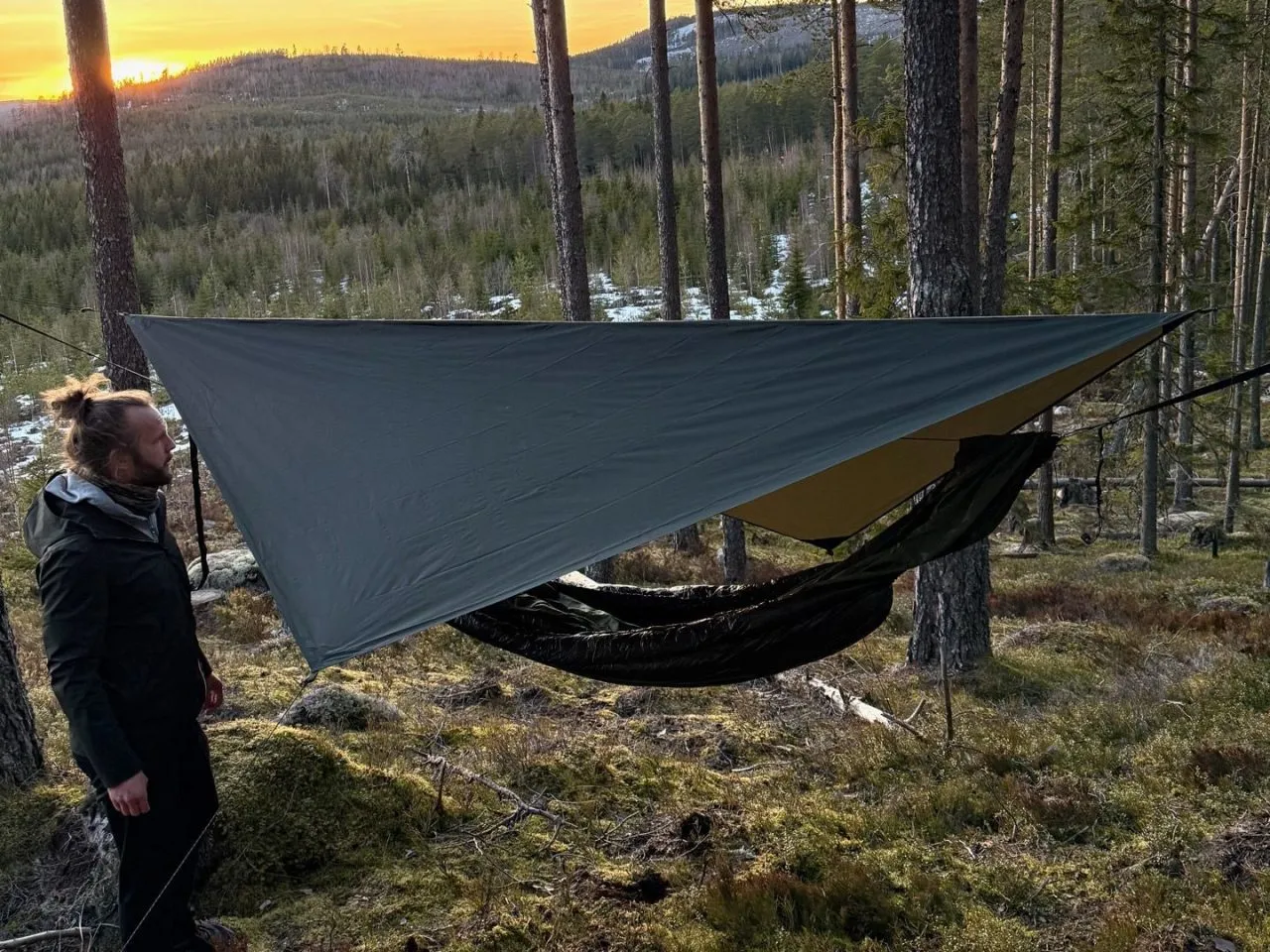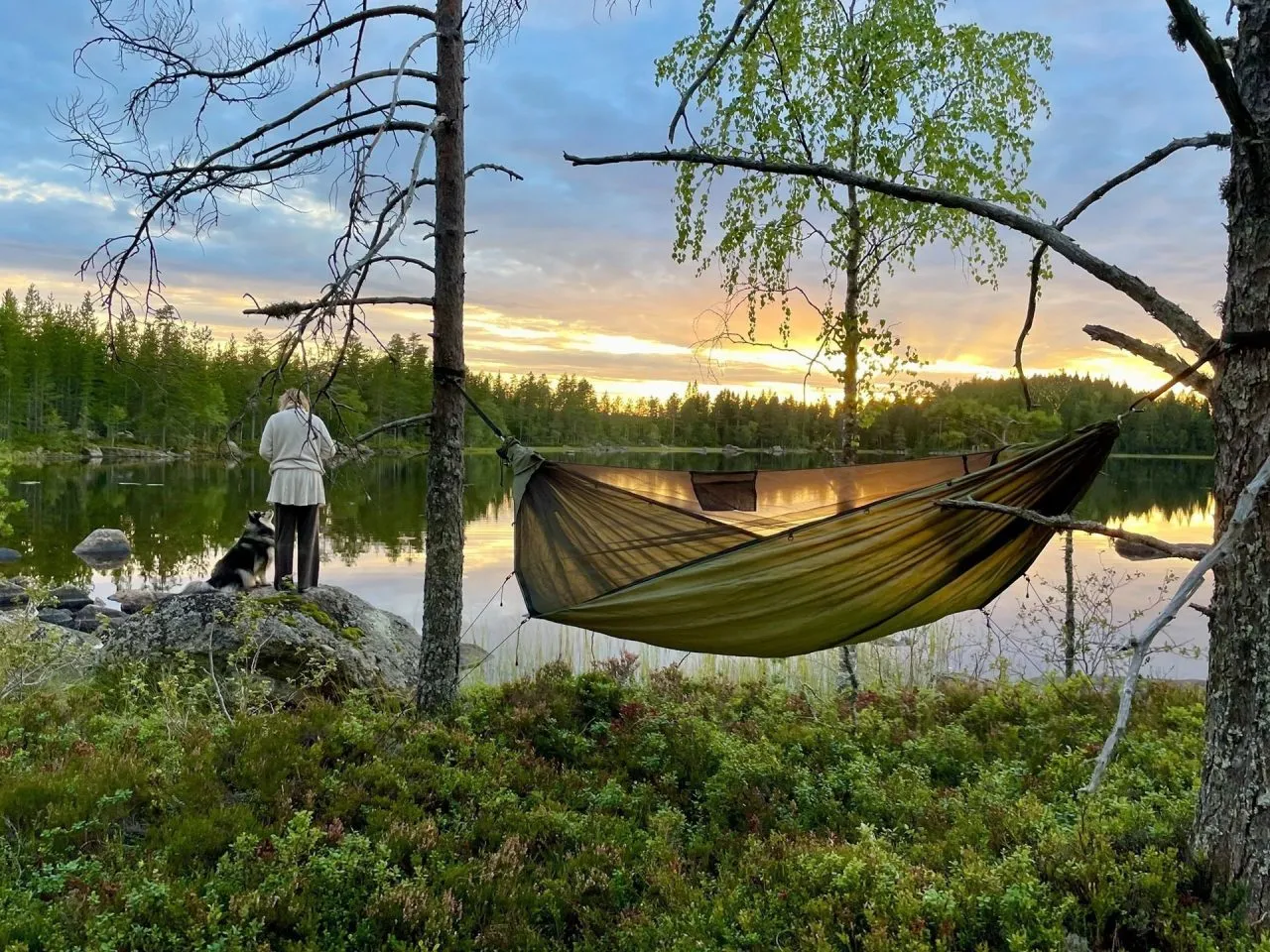
A hammock tent is really three parts held together: a hammock, a bug net and a tarp over the top for rain. The simplest and lightest way to build that is yourself — an asymmetric hammock with an integrated net, plus a tarp when you need one. The hammock alone starts at €159 and weighs 690 g. Want to lie dead flat instead? Ready-made tent-hammocks like Amok Draumr and Haven Tent exist, but they weigh two to three times as much and cost noticeably more. A genuine tree tent, Tentsile-style, is something else entirely: a tent slung between trees, not a hammock at all.
“Do you sell hammock tents?” lands in the inbox most weeks, and the two people asking it almost never mean the same product. One has seen a photo of someone lying flat in a fabric cocoon between two pines. Another means a hammock with a net draped over their face. A third is picturing a tent floating between three trees. Three different things, one search term. After fifteen years around hammocks I’ve stopped guessing and started sorting it out properly instead.
One more thing before we get into it: I’ve sold, rigged and slept in gathered-end hammocks for years — that’s the ground I stand on. Amok and Haven I’ve followed closely but never slept in, so I’ll describe them as what I know, not a night I made up. Tree tents have never been in my workshop, and for those I won’t hand you exact grams or euros either.
Three things that sound like almost the same thing
The terminology is the whole problem. People write “hammock tent,” “tent-hammock” and “tree tent” for products that work completely differently — and “hammock tent” and “tree tent” get mixed up just as easily. Here’s what the three categories actually look like:
Path 1 — hammock, tarp and net. An ordinary camping hammock with an integrated bug net and a tarp pitched over it as a roof. It’s what most people actually mean when they write “hammock tent” — and it’s the path I’ve walked myself.
Path 2 — the tent-hammock in one. A ready-built construction where the hammock body, net and usually a set of spreader bars are joined together so you lie flat instead of diagonally. Amok Draumr and Haven Tent are the two names that matter here. Flatter sleep, but heavier and pricier.
Path 3 — real tree tents. A tent with a floor, hung between (usually three) trees. Tentsile is the brand people picture. It’s not a hammock at all — it’s a floating tent, built so you and maybe the kids sleep on a flat, raised floor rather than hanging in a curve.
| Hammock + tarp + net | Tent-hammock in one | Tree tent | |
|---|---|---|---|
| Example | Momo Jord Hammock + tarp | Amok Draumr, Haven Tent | Tentsile-style |
| What it is | Hammock with net + separate tarp over the top | Hammock body, net and bars in one unit you lie flat in | Tent with a floor slung between (usually three) trees |
| Lying position | Diagonal, flattens out but not dead flat | Genuinely flat | Flat floor — it’s a tent |
| Weight | 690 g hammock + net / ~1.1 kg with suspension | 1.3–3.5 kg depending on model | Several kilos |
| Price, EU buyer | €159 hammock · tarp €79 | from €225, complete system more | Priciest of the three |
| Integrated bug net | Yes | Yes | Comes with the tent fabric |
| People | 1 | 1 | 1–3 |
| Where to buy | Ships from Sweden, no customs | Amok: EU stock, no customs · Haven: EU stock (Slovakia), VAT included | Outdoor retailer or import |
Weights for the hammock and the tent-hammocks exclude the tarp and any insulation underneath — add those and every system gets heavier. Prices and specs checked with each manufacturer in July 2026.
What actually makes a hammock tent good
A good night outside comes down to four things, whether you build your own or buy a ready-made system.
The bug net. In Northern and Central European summer forests, roughly May to September, a net isn’t optional. What matters is that it’s integrated and stows away when the mosquitoes are asleep. Some brands sew it in fixed, others sell it separately — and that’s usually when a “cheap hammock” ends up costing more than it looked.
A bug net you can’t stow away is one you’ll be swearing at by August.
Length and shape. Lie in a hammock that’s too short and you fold into a banana with sore calves. An asymmetrically cut hammock lets you lie diagonally across the fabric, flattening out far more than a straight, symmetric one — though it never goes properly flat. Only the spreader-bar tent-hammocks get you there.
Insulation from below. The thing people miss first. The air under you cools your back even on a mild summer night, because your weight presses the fabric flat and kills whatever loft it had. The fix is an underquilt — a down or synthetic quilt hanging on the outside of the hammock. What temperature rating you need gets its own guide, plus a dedicated winter guide if you want to keep sleeping out once it turns cold.
Weather protection. The roof — the tarp. It decides whether the rain stays outside, and it’s also the thing people most often buy wrong. More on shapes further down.
Path 1: hammock, tarp and net — the simple way
This is what I recommend to most people who write in. Take a camping hammock with an integrated net, hang a tarp over it, add insulation once you’re sleeping in colder weather. Three parts, each replaceable on its own — you understand the whole system after one night.
In numbers: our hammock weighs 690 g with the net, 1090 g with suspension, carabiners, stabiliser lines and a stuff sack. 350 cm long, 140 cm wide, 150 kg capacity, in 70D ripstop nylon that’s PFAS-free. €159, complete with everything you need to hang it between two trees — then you add a tarp, and when you’re ready, an underquilt. Designed in Sweden, shipped from Sweden across the EU: free over €250, about a week to most of the continent, 14-day returns, no customs, no import VAT.
Want it all in one purchase? Our hammock kit bundles the hammock, suspension, tarp and underquilt in whatever sizes you want, plus a stuff sack — priced from €159 as you build it, so you’re not chasing five SKUs across five shops. The warmest underquilt, the one rated for real winter, is between batches right now — worth keeping an eye on rather than settling for something colder if that’s the one you’re after.
The tarp: don’t buy storm cover if you’re sleeping in a summer forest
A tarp is measured on how much it covers, how much it weighs, and how it’s cut. Our Asym Tarp is cut to match the diagonal lying position: 360 × 310 cm, 350 g on its own (455 g with stakes, lines and stuff sack), €79, in 20D ripstop with a silicone-coated PU3000 face. It covers the hammock tightly and efficiently, weighs almost nothing, and packs down to a fist. It isn’t built for storms and hard gusts, though — for that you want a bigger, square tarp pitched low.
That trade-off — light and asymmetric versus heavy and versatile — is why tarp shape gets its own write-up, including the square tarps from DD and Fjällräven’s Abisko, in the roundup of the best hammock tarps. Read that one if rain is your main worry.
Path 2: the tent-hammock in one (Amok and Haven)
Here’s where the honest competition lives, and I’ll be generous, because there’s one thing Path 1 genuinely can’t do: put you dead flat on your back. A gathered-end hammock flattens out a lot on the diagonal, but it never becomes a bed. Tent-hammocks do — and for some back sleepers, that’s the difference between sleeping and not sleeping.
| Momo Jord (hammock + net) | Amok Draumr 5.0 | Haven Tent (base) | |
|---|---|---|---|
| Price, hammock | €159 | €250 | from around €225 |
| Weight | 690 g / 1090 g with suspension | 1329 g (system, no tarp/pad) | 3.16 kg (complete system) |
| Lying position | Diagonal, asymmetric | Genuinely flat + chair mode | Genuinely flat |
| Bug net | Integrated | Integrated | Integrated |
| Tarp | Separate (€79) or in the kit | Bought separately | Rainfly included |
| Insulation underneath | Underquilt separate | Inflatable pad required (from around €130) | Insulated pad included* |
| Where to buy | Ships from Sweden, no customs | EU stock, no customs | EU stock (Slovakia), VAT included |
Amok Draumr is a Norwegian build: you lie across a platform held flat by aluminium spreader bars, and the same straps convert it into a supportive chair. Genuinely flat, integrated net, and — its strongest practical point — it ships from EU stock with VAT included and no customs, even though the brand is Norwegian. The trade-off is price and weight: €250 for the hammock alone, and a complete weatherproofed system comes in north of about €490 once you’ve added a tarp and the required inflatable pad, which alone starts from around €130. Worth the money if you want the flat lie and the chair mode — the full breakdown is in our Amok Draumr vs Momo Jord comparison.
Haven Tent is the American lay-flat design: spreader bars at the head and foot, plus a thick air pad, give a genuinely flat sleeping surface. Net, rainfly, straps and pad ship in the same box, and — despite being a US brand — it’s fulfilled from EU stock in Slovakia with VAT included, so no customs bill either. The price for flat is weight: the base kit weighs 3.16 kg, roughly three times a hammock that’s just over a kilo. An ultralight Spectre version, around 1.95 kg, narrows the gap — though the price climbs with it. The full trade-off is in our Haven Tent vs Momo Jord comparison.
So: if lying flat is keeping you awake, look at these two. If you sleep fine on the diagonal, or you’re carrying your pack a long way, simplicity and price pull hard the other way.
“But don’t I actually need to lie flat to sleep well?”
Some people genuinely do. If you’re a strict back sleeper, or your back just doesn’t tolerate a curve, the extra weight and money buys something real, not a marketing claim. Most people, though, adapt to the diagonal within a night or two and sleep fine — the asymmetric cut does most of the work. If you’re not sure which camp you’re in, the cheapest way to find out is Path 1 first: a fraction of the outlay, and the tarp and underquilt aren’t wasted money later either — they work under the next hammock you own too.
Path 3: real tree tents — a different animal entirely
When someone writes “tree tent,” or asks about camping in the trees with room for the kids, they usually mean a Tentsile: a tent with a floor strung between three trees, so you camp on a flat, raised surface instead of hanging in a curve. It’s not a hammock, and shouldn’t be bought as one. Some models take two to three people, which is why they turn up on family trips and for anyone sleeping above wet or uneven ground.
I’ve never had a Tentsile in the workshop, so I won’t give you exact figures. What I can say about the category: it’s consistently heavier and pricier than a hammock, you usually need three trees at the right angles to rig it, and it’s overkill if you just want to hang alone for one night. Travelling light and fast — wrong tool. Camping a couple of people on a floor between the trees — right tool, but then you’re shopping for a tent, not what most people mean by “hammock tent.”
Already have a hammock but not the rest of the kit?
If you’re already hanging in a DD, a Ticket to the Moon, an ENO or anything else with gathered ends, and you’re just missing the net or the rain cover, our Asym Tarp and Underquilt aren’t fussy about whose hammock they hang under — the tarp pitches on two lines regardless of brand, and the underquilt hangs on the outside the same way on any gathered-end hammock. You don’t need a whole new hammock to fix a cold back or a wet night.
Who this actually suits
Matched honestly, without pointing everyone at the same product:
- Simplest, lightest, solo, no customs — a hammock with an integrated net plus a tarp. Path 1. Easiest to learn, lightest to carry, least money.
- Need to lie dead flat — Amok Draumr for flat-plus-chair from EU stock, or Haven Tent for fully flat sleep with everything in one box. Budget for more weight and more money either way.
- Camping a couple of people, or need a floor between the trees — a Tentsile-style tree tent. A different animal, heavier and pricier, but right when that’s genuinely what you need.
Still unsure about the hammock itself, rather than the roof over it? I’ve lined up the usual suspects in the big camping hammock comparison. And for where you’re actually allowed to hang in Scandinavia’s forests, and how to do it without leaving a mark, there’s a guide to that too.
FAQ
What’s the difference between a hammock tent and a tree tent?
A hammock tent is a hammock with a bug net and a tarp over it, hung between two trees. A tree tent is an actual tent with a floor strung between (usually three) trees, and you lie on a flat surface. Different products, different weight, different price.
Do I need a bug net for a hammock tent?
In most of Northern and Central Europe’s summer forests, roughly May to September, yes. Momo Jord’s hammock has the net built in and stowable, so it’s not an extra purchase. On several budget hammocks the net isn’t included, and the bill often ends up higher than it looked at first.
Does a hammock tent hold up in rain?
Yes, with the right tarp. A light asymmetric tarp is plenty for normal European summer weather; for storms and hard gusts you want a bigger, square tarp pitched low. Our Asym Tarp is the light option — the full rundown of shapes is in the tarp roundup.
Won’t I get cold from underneath in a hammock?
Without insulation, yes — the air under you cools your back even on a mild night, because your weight presses the fabric flat and kills the loft. The fix is an underquilt on the outside of the hammock, or a sleeping pad inside. Which temperature rating you actually need is covered in the underquilt guide.
Can you sleep completely flat in a hammock tent?
Flattest is a tent-hammock with spreader bars — Amok Draumr or Haven Tent. An asymmetric hammock flattens a lot on the diagonal but never goes dead flat. A plain, symmetric hammock is the most banana-shaped of the three.
How much does a hammock tent weigh?
The simple route — hammock, net and a light tarp — lands around a kilo. A tent-hammock weighs 1.3 to 3.5 kg depending on the model. A tree tent weighs several kilos. The flatter the lie, the heavier the pack.
The simple route starts with a hammock with an integrated net and a light tarp over it — or the whole system in one purchase through the hammock kit from €159. Convinced you need dead flat? Amok or Haven are honest choices, even if your wallet complains. Either way, the simplest hammock tent is the one you can rig in the dark with gloves on — you add the flat lie, the storm tarp or the winter underquilt later, once you actually notice you’re missing it.
Prices and specs checked with each manufacturer in July 2026. *Haven’s “from” price may not include the insulated pad in every configuration — check at checkout.