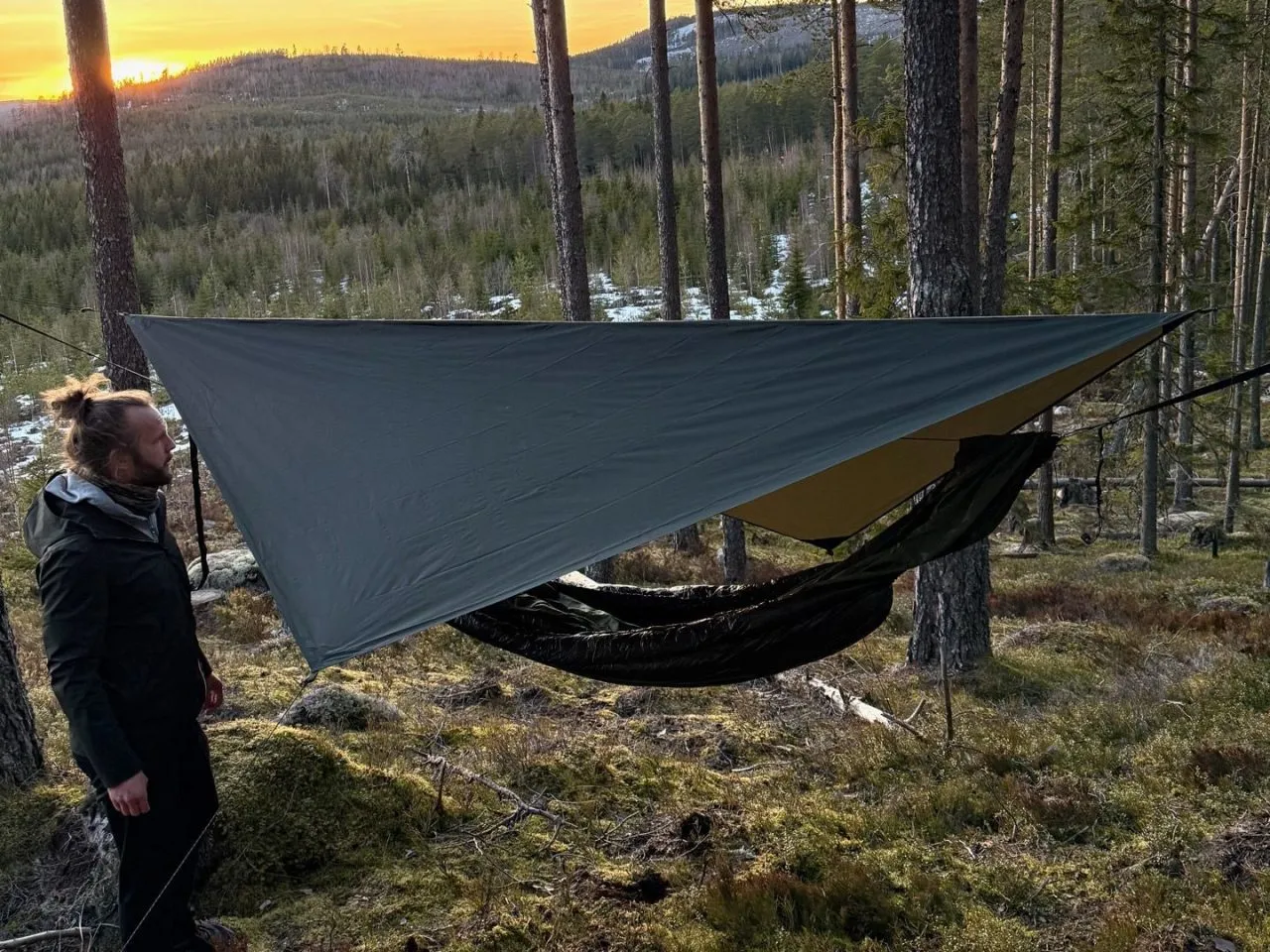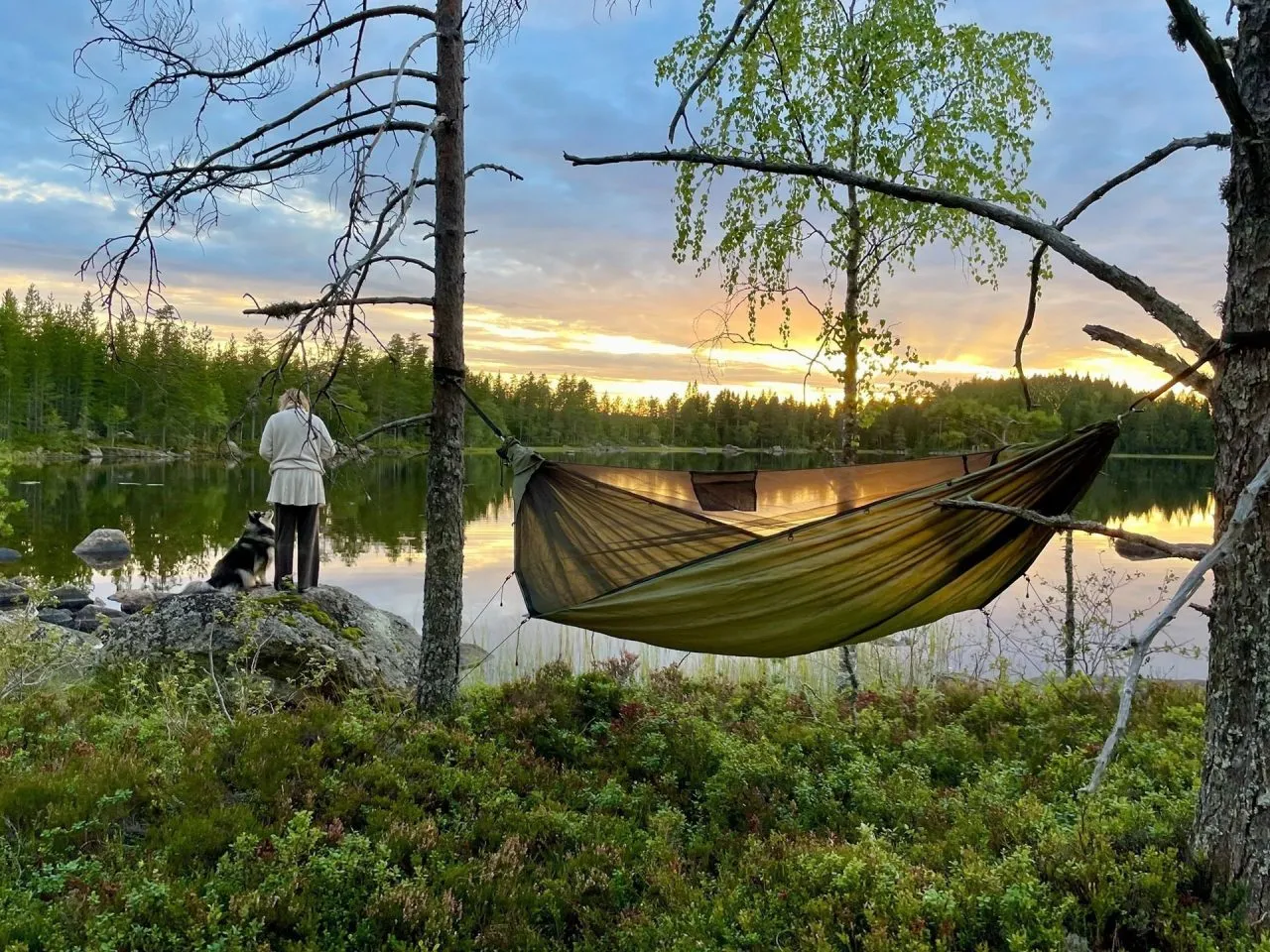
Scandinavia is a dream destination for hammock camping. With the Nordic right to roam as your backbone, you can pack your hammock and sleep almost anywhere — in old-growth forest in Dalarna, among the lakes of Värmland, or under the northern lights in Lapland. No landowner to ask, no fees to pay, just you and the forest.
I have slept in a hammock across the Nordic wilds for over 15 years. This is everything I wish someone had told me at the start.
Why a hammock in the wild?
A tent has its place — but a hammock gives you a freedom a tent can never match. No need for flat ground (always harder to find than you think), you sleep dry even in rain, and you wake up without the morning stiffness a tent floor gives you.
And in the Nordics you have a unique advantage: the right to roam (allemansrätten in Swedish, allemannsretten in Norwegian, jokamiehenoikeus in Finnish). It lets you pitch your hammock more or less wherever you like, as long as you show consideration. There are few places in the world where you have the same freedom to sleep out in nature.
The right to roam and hammocks — what are the rules?
The right to roam grants you access to nature, but it comes with responsibility. Here is what applies specifically to hammocks:
- You may hang your hammock between trees — in forest, by lakes, on the fells. No permits needed.
- Not near homes — stay out of sight of private dwellings and their immediate private zone.
- Don’t damage the trees — use wide tree-friendly straps, never rope or wire. The straps spread the load and leave no marks.
- Leave no trace — carry out all your rubbish. The spot should look untouched when you leave.
- Only a night or two in the same place — then move on (on the high fells you have more freedom, and a landowner can grant permission for longer).
In short: don’t disturb, don’t destroy. With a hammock it is easier to honour that principle than with a tent — you literally leave no marks on the ground.
The best places for hammock camping in Scandinavia
The Nordic countries offer endless good hammock spots. Here are my favourites after 15 years — all in Sweden, and all easy to reach for any Nordic traveller:
Dalarna — classic old-growth forest
The areas around Orsa and Fulufjället serve up old-growth forest with perfect pines: straight trunks, 4–5 metres between trees, soft ground beneath. Head south toward Lake Siljan and you’ll find calmer lakes to wake up by.
Värmland — lakes and forest
Glaskogen nature reserve is a mecca for hammock camping. Hundreds of lakes, mile after mile of forest, and almost no people. Perfect if you want to combine paddling with a night in the hammock.
Norrland — wilderness without end
From the mountain forests of Jämtland to the primeval forests of Norrbotten — the further north you go, the more solitude you find. In summer the midnight sun gives you extra hours of daylight. Bear in mind that mosquitoes can be intense in June and July — a hammock with a bug net is worth its weight in gold.
The west-coast forests
Underrated! The oak woods of Bohuslän and the beech forests of Halland offer sheltered spots with a milder climate. Perfect for autumn and spring camps.
Tip: Look for old-growth forest with large pines and 4–5 metres between trunks. Avoid young plantations — the trees are too thin and too dense.
The gear you need for hammock camping
Here is the core kit, from most important to nice-to-have:
- Hammock — at least 300 cm long. The Momo Jord Hammock is 350 cm, which gives you room to lie diagonally (the key to comfortable sleep).
- Suspension straps — wide straps that don’t damage the trees. Never rope.
- Underquilt — insulation beneath the hammock. Essential from September to May. Read our complete underquilt guide.
- Tarp — rain protection overhead. Always needed in the Nordics (yes, even in July).
- Topquilt or sleeping bag — insulation on top of you.
- Sleeping pad as backup — a thin foam pad works if the underquilt isn’t quite enough.
Season guide — gear month by month
Summer (June–August)
The easiest season. A hammock, a tarp and a thin quilt are all you need. An underquilt is optional but lovely if nights dip below 10°C — then the UQ300 (Summer, 300g) is plenty.
Autumn (September–November)
Now it gets real. Nights can drop below freezing. The UQ500 underquilt (500g, Spring & late autumn) gives comfort down toward 0°C. The tarp becomes more important — rain and damp are the norm.
Winter (December–February)
The ultimate challenge — and reward. With the UQ800 underquilt (800g, Winter), a winter sleeping bag or topquilt, and a tarp with side walls, you sleep warm down to roughly −10°C (customer-tested) — and colder still with true expedition gear. Read our complete winter guide.
Spring (March–May)
Tricky weather — sunny by day, cold at night. The UQ500 underquilt + tarp is your standard setup. Keep an extra fleece in your pack.
Beginner tips — start right
- Test at home first — hang the hammock in the garden and sleep a night. Learn your gear before you head into the forest.
- Master the diagonal lie — don’t lie straight in the hammock like a banana. Lie at an angle, roughly 15–30 degrees off-centre. The surface flattens out and your back will thank you.
- Right hang height — the lowest point of the hammock should sit at bench height, about 45–50 cm. Then you can sit in it like a chair, and if you fall out you land safely.
- The 30-degree rule — the suspension straps should form roughly a 30-degree angle to the horizontal. That gives the best comfort and the least strain on the trees.
- Tarp first — if rain looks likely, pitch the tarp before the hammock. You don’t want to unpack your kit in the rain.
- Watch our video guide — how to set up your underquilt step by step.
Complete packing list for hammock camping
| Gear | Summer | Autumn/Spring | Winter |
|---|---|---|---|
| Hammock | ✓ | ✓ | ✓ |
| Suspension straps | ✓ | ✓ | ✓ |
| Tarp | ✓ | ✓ | ✓ (with side walls) |
| Underquilt UQ300 (Summer) | Optional | — | — |
| Underquilt UQ500 (Spring & late autumn) | — | ✓ | — |
| Underquilt UQ800 (Winter) | — | — | ✓ |
| Topquilt / sleeping bag | Thin | 3-season | Winter bag |
| Sleeping pad (backup) | — | Optional | ✓ |
| Warm hat + gloves | — | ✓ | ✓ |
| Headlamp | ✓ | ✓ | ✓ |
| Water bottle / flask | ✓ | ✓ | ✓ (hot water) |
| Stove / cooking | ✓ | ✓ | ✓ |
Free shipping on all orders over €250 within the EU. See the full range in our shop.
Questions about hammock camping in Scandinavia? Get in touch — we’re happy to help. With the right gear and a little know-how, the whole of the Nordic wild becomes your bedroom.