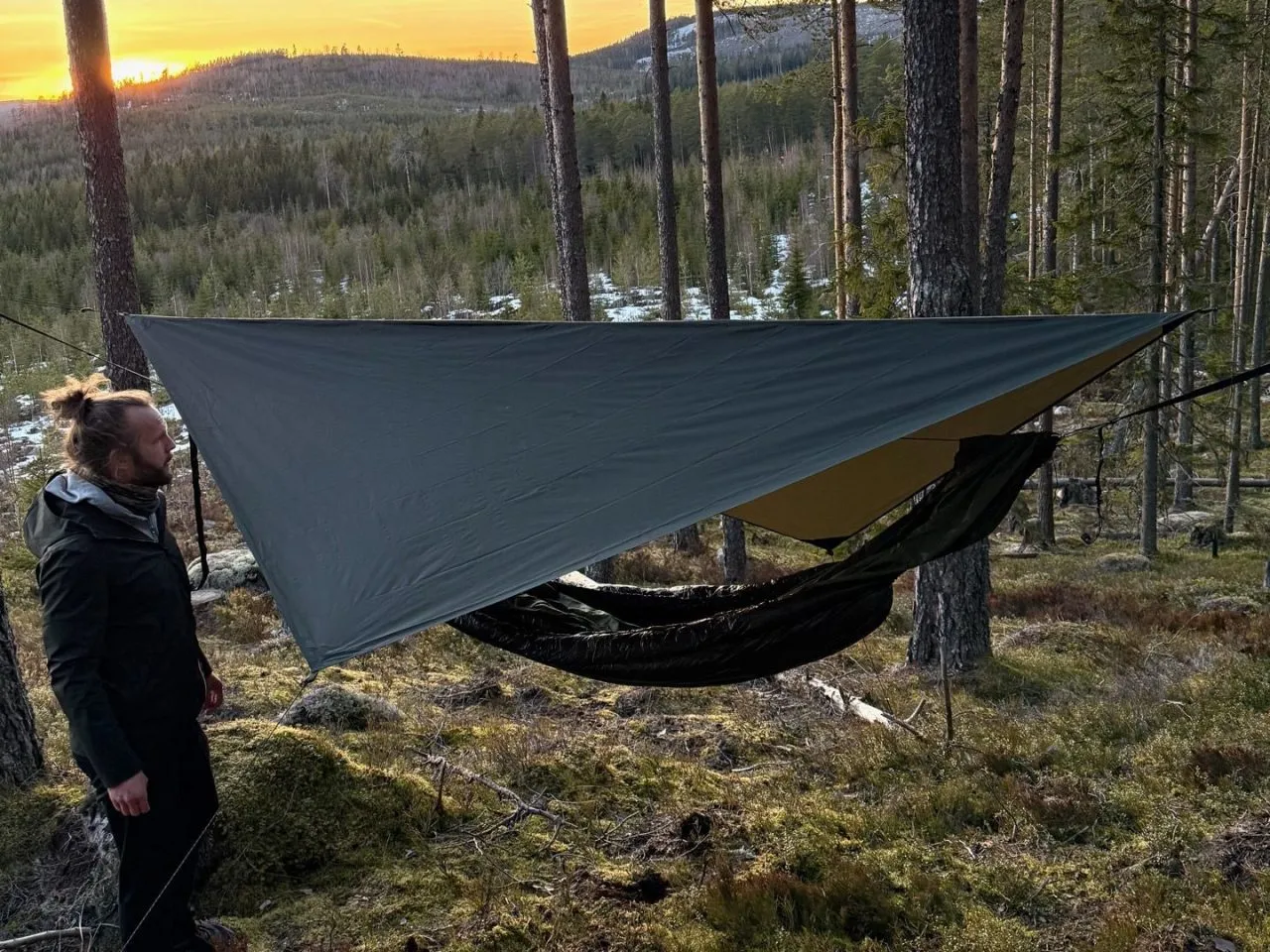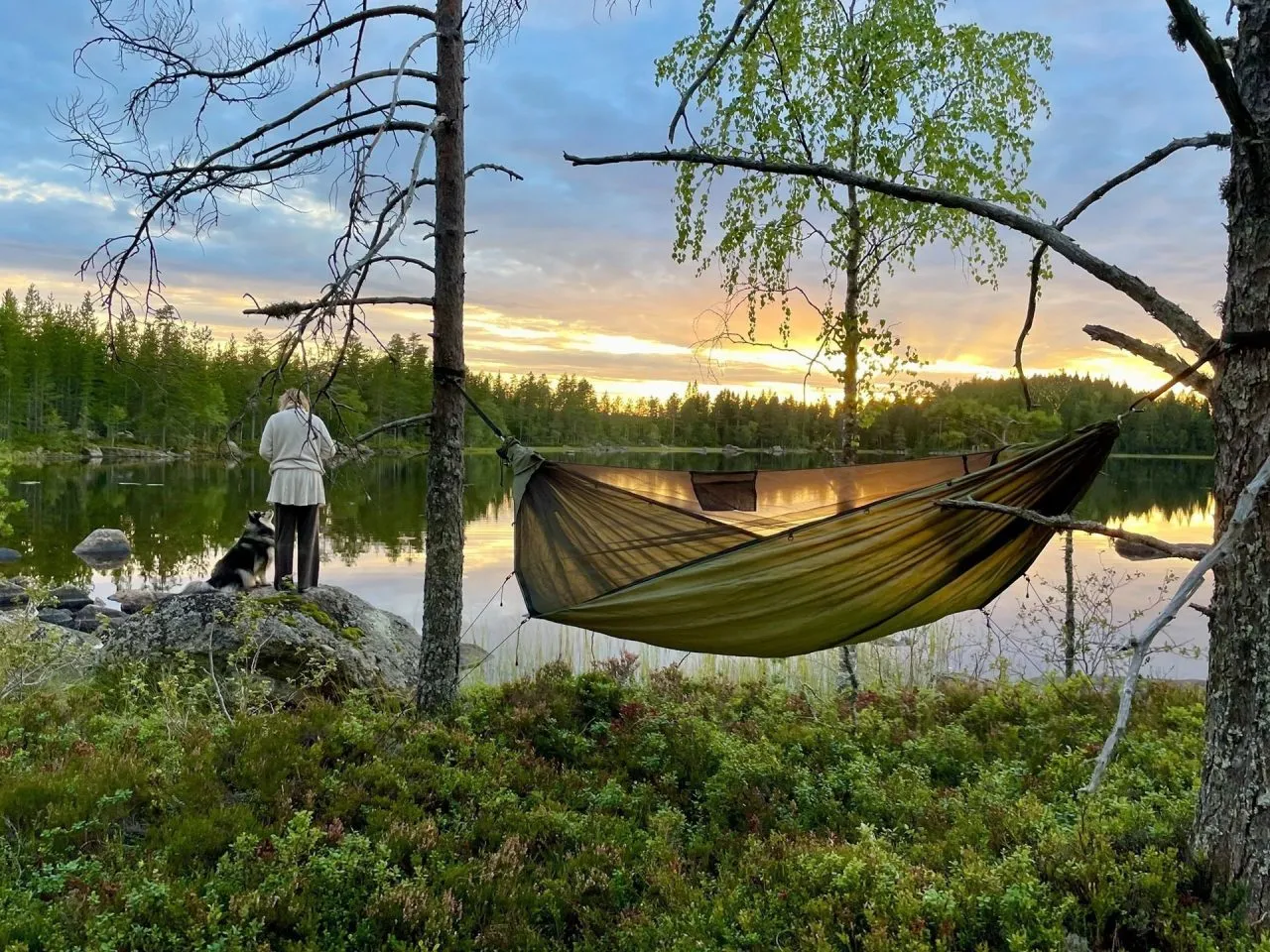
Minus ten degrees. Clear, starlit sky. Total silence — except for the snow that creaks when a branch bows under its weight. You lie in your hammock, warm and comfortable, with frost on the tarp above you.
It sounds impossible to most people. But with the right gear and technique, winter hammocking is actually more comfortable than sleeping in a tent in winter. No condensation on the inner wall, no frozen ground beneath you, and you sleep raised above the cold air that pools at ground level.
I have slept in a hammock through winter for over 15 years. This is everything you need to know.
The great enemy: cold from below
In a hammock, your underside is exposed to cold air from every direction. This is where most people go wrong — they pack a thick sleeping bag and assume it is enough. But the sleeping bag gets compressed under your body weight. Compressed material does not insulate. You are quite literally lying on a thin layer of fabric with sub-zero temperatures right beneath you.
Two laws of physics are working against you:
- Convection — cold air circulates under the hammock and pulls heat away from your body. The more wind, the worse it gets.
- Conduction — the hammock’s thin nylon fabric leads heat straight from you into the cold air.
The solution? An underquilt. It hangs freely beneath the hammock, never gets compressed, and creates an insulating layer of air that stops both convection and conduction. Read our complete underquilt guide for a deeper understanding.
The complete kit list for winter hammocking
Here is what you need to sleep warm below freezing:
Insulation
- Underquilt UQ800 (Winter, 800g down) — a must. 850FP RDS-certified down. Customers have slept warm down to around −10°C. This is the difference between a magical winter night and pure misery.
- Topquilt or winter sleeping bag — for sub-zero nights. A topquilt has the advantage that you can vent without opening a zip.
- A warm hat — you lose 10–15% of your body heat through your head. A proper wool beanie is non-negotiable.
Shelter
- A tarp with doors — the Momo Jord Winter Tarp gives full coverage. Drop the side panels to block wind and snow. It creates a microclimate that can sit 5–10°C warmer than the outside air.
- Insulating suspension straps — cold is conducted through metal parts. Avoid metal carabiners in direct contact with the hammock where you can.
The hammock
- Momo Jord Hammock (350 cm) — the extra length gives you room for the diagonal lay even in thick winter clothing. 70D ripstop nylon handles the load of heavy gear.
The layering system — how to dress right
Winter hammocking is all about layers. The same principle as any winter activity, but with a twist: you are not moving during the night, so your body produces almost no heat of its own.
- Base layer — merino wool or synthetic next to the skin. Never cotton. Cotton absorbs moisture and chills you.
- Mid layer — fleece or a thin down vest. Depending on the temperature you may need several mid layers.
- Underquilt + topquilt/sleeping bag — your primary insulation system. The UQ800 underquilt below, topquilt or sleeping bag above.
- Extremities — thick wool socks, down mittens, a warm hat. Feet and hands go cold first.
Important: Do not go to bed sweaty. Change into dry clothes before you crawl in. Moisture in your clothing means cold through the night.
Practical tips from 15 winters in the woods
- A hot water bottle in your sleeping bag — fill a Nalgene bottle with boiling water and tuck it by your feet. It keeps you warm for hours and gives you lukewarm drinking water in the morning.
- Eat fatty food in the evening — nuts, cheese, chocolate. Fat gives slow, steady energy that keeps the body warm through the night.
- Pitch the hammock in the lee — a sheltered spot makes an enormous difference. A hillside, dense forest or rock ledge that blocks the prevailing wind.
- Not near water — lakes, rivers and wetlands create cold, damp air. Move 100 metres up the terrain and you can gain 3–5 degrees.
- Not in a hollow — cold air is heavy and collects in dips and valley bottoms. Hang your hammock on a gentle slope instead.
- Do not hang too high — the higher the hammock hangs, the more exposed it is to wind. Bench height (45–50 cm) is plenty and lets the tarp shield you.
- Test at home in milder cold first — sleep a night at −5°C in the garden before you head out on a mountain trek at −20°C.
Temperature zones — what can you handle with which gear?
| Temperature | Underquilt | On top | Tarp | Notes |
|---|---|---|---|---|
| 0 to −5°C | UQ500 (500g) | 3-season sleeping bag | With doors | The edge of the UQ500. Works with good clothing. |
| −5 to −10°C | UQ800 (800g) | Winter sleeping bag / Topquilt | With doors | The UQ800 starts to show its strength. |
| −10 to −15°C | UQ800 (800g) | Winter sleeping bag + extra layer | With doors, closed down | Every layer earns its place. A hot water bottle is recommended. |
| Below −15°C | UQ800 (800g) + extra sleeping pad | Expedition sleeping bag | Fully closed tarp | Expert territory. Combine with a sleeping pad for extra insulation. |
Common mistakes in winter hammocking
- Underestimating the cold — “it was only minus five” say all the people who froze. Sleeping still in a hammock is colder than you think. Over-pack rather than under-pack.
- Too thin an underquilt — a summer or 3-season quilt in winter cold is like sleeping without a duvet. The UQ800 exists for a reason.
- No tarp, or too small a tarp — the tarp creates your microclimate. Without it the wind blows straight through your insulation. The Momo Jord Winter Tarp gives you the protection you need.
- The hammock hung too high — wind speed rises with height. Hang low, in the lee, with the tarp closed down.
- Cotton clothing — cotton is the outdoor world’s number one enemy in winter. Merino wool or synthetic, full stop.
- Forgetting the extremities — warm feet, warm hands, warm head. Three things that make all the difference.
- No test at home — your first winter night should not be far from civilisation. Test in the garden, adjust, test again.
Winter hammocking is not for everyone — but for those who try it, it quickly becomes a favourite. The silence of a winter forest, the starry sky through the tarp, the feeling of beating the cold with smart gear instead of brute force.
Ready to try? Start with the right insulation: the Momo Jord UQ800 Underquilt (Winter) + Topquilt + Winter Tarp. Watch our video guide for setup tips. Free shipping over €250.