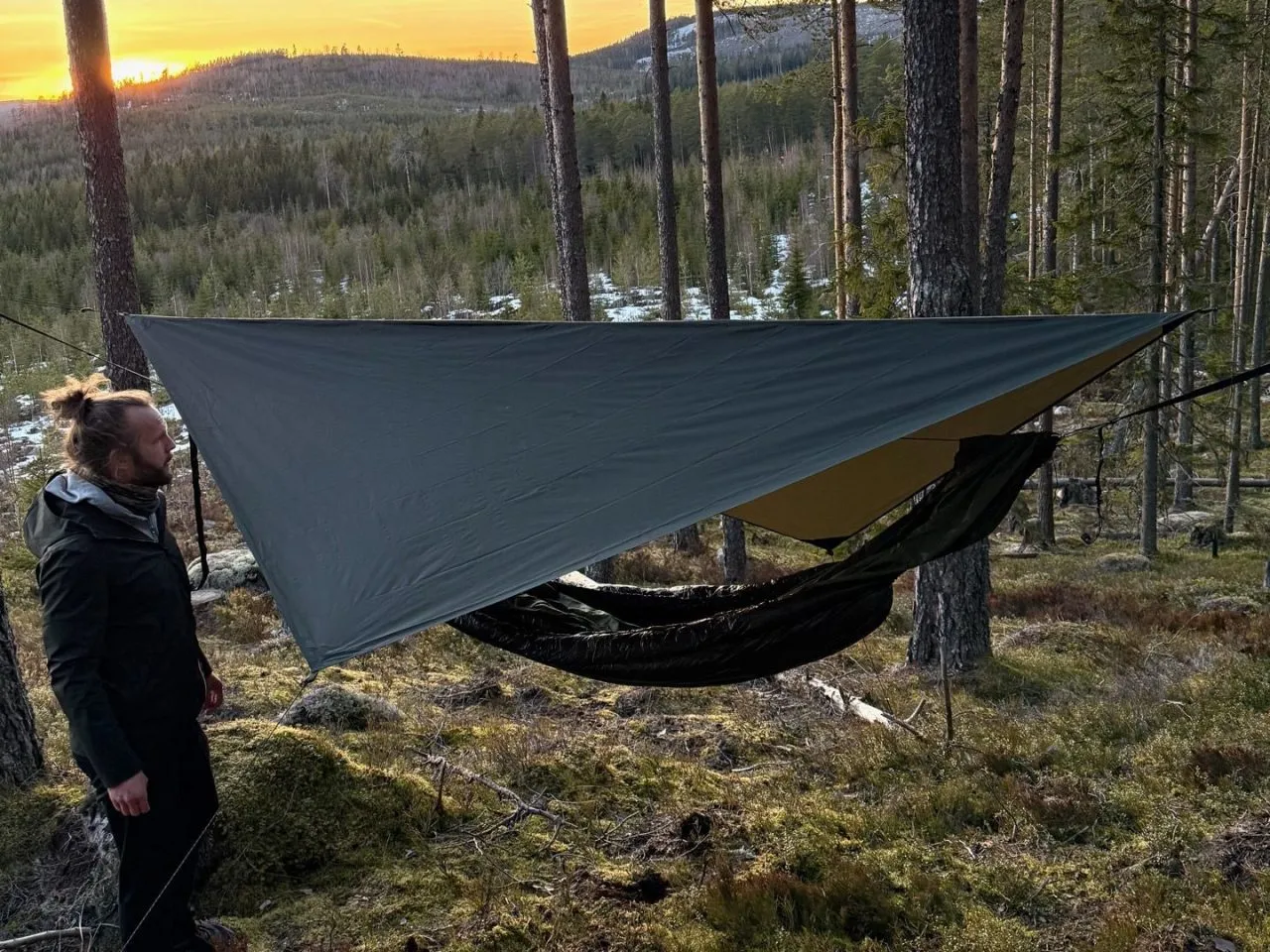
The best camping hammock for most people in the EU in 2026 is an asymmetric gathered-end with an integrated bug net, long enough to lie on the diagonal, and built to take an underquilt underneath. That’s exactly how we built the Momo Jord Hammock: €159, 690 grams, the net already sewn into the price. Want to sleep completely flat instead? Amok Draumr is the more honest pick. Want the cheapest net-equipped hammock that still holds up? DD Frontline is hard to beat. The whole field for 2026 is laid out below, side by side.
There are more camping hammocks on the market now than when I started selling them fifteen years ago. Most of the brands in this comparison have hung in my workshop at some point along the way — I was a reseller for years before I got tired of selling other people’s compromises and drew up a line of my own. Which means I didn’t put this list together from a search engine. I’ve had these hammocks in my hands, and I’ve got nothing to gain from stretching the truth about the competition.
A few of them — Amok, Haven, Warbonnet — I’ve tracked for fifteen years without sleeping in one myself. On those I’m writing from industry knowledge, not a night out I never had. The rest I’ve sold.
What makes a camping hammock good
A lounge hammock for the garden and one you’re sleeping two rainy nights in are not the same product. Five things separate them.
The bug net makes a hammock sleep-ready anywhere in Northern or Central Europe. Mosquitoes and midges find you around dawn no matter how tired you are, and a net you rig separately is the thing you leave at home. An integrated net weighs less, costs less in total, and is always exactly where it should be.
Length and cut decide how flat you lie. A gathered-end hammock pulls the fabric into a shallow curve; on the diagonal that curve flattens out, and an asymmetric cut flattens it further because the seam follows that exact diagonal. Shorter hammocks around 270–300 cm force more curve into your spine. Ours runs 350 cm — what other brands call XL.
Insulation from below is what beginners miss. The air underneath you pulls heat out of your back long before the air around you does. A pad inside the hammock helps; an underquilt hung underneath is better — true of every hammock on this list, whatever the brand.
Weight and pack size only matter once you’re carrying everything. A complete gathered-end runs around a kilogram; flat-lay systems (Amok, Haven) land at 1.3–3.5 kg once the pad and tarp are counted in. Walk any real distance and it shows up in your shoulders.
Weather protection — a tarp over the hammock — is rarely included in the headline price. Hennessy bundles it, Amok sells it as an add-on, DD and ENO don’t sell one with the hammock at all. Always price the roof in before you compare.
Camping hammocks 2026 — side by side
Six hammocks you can actually buy somewhere in the EU without a fight, plus three specialist picks further down. Ours is in bold — not because it wins every column, because it doesn’t, but because it’s the one I know down to the last seam.
| Hammock | Type | Price (approx.) | Weight | Bug net | Pack size | Capacity | Where to buy |
|---|---|---|---|---|---|---|---|
| Momo Jord Hammock | Asymmetric gathered-end | €159 complete with suspension | 690 g / 1,090 g full system | Yes, integrated | Compact stuff sack | 150 kg | Sweden, ships across the EU, no customs |
| Amok Draumr 5.0 | Flat-lay / tent-style | €249.95 hammock only; full weatherproof system €500+ | 1,329–1,434 g (before pad/tarp) | Yes, fixed | 16×22 cm | 180 kg | Norway, ships from EU stock |
| Hennessy Explorer Deluxe Zip XL | Asymmetric gathered-end (+ tarp) | €179.95 official EU store; ~€230–290 via retailers | ~2,040 g with tarp | Yes, fixed | not stated | 136 kg | Canada, wide EU retail |
| DD Frontline | Symmetric gathered-end | £49 direct; ~€72–88 via EU stockists | 850 g / ~1.17 kg complete | Yes, sewn-in | 28×17×12 cm | 125 kg | UK, wide EU stockists |
| Ticket to the Moon Pro | Symmetric gathered-end | €139.95 | 880 g | Yes (Pro only) | not stated | 150 kg | Indonesia, EU-distributed |
| ENO JungleNest | Symmetric gathered-end | ~€180–200 (hammock + net only) | 567 g | Yes, stowable | not stated | 136 kg | USA, EU stockists |
Prices and specs checked July 2026 with each manufacturer, official EU stores, and European retailers. Competitor prices move — hence the date stamp. Where a pack size says “not stated,” the manufacturer hasn’t published one; I’m not going to invent one.
Who’s best at what
Momo Jord Hammock — designed in Sweden, simple, net included
I’m biased, but here’s why: asymmetric gathered-end, 350×140 cm, integrated midge-proof net, 70D PFAS-free ripstop, rated to 150 kg. 690 g for hammock and net, 1,090 g complete with straps, carabiners, guy lines and stakes. €159, not a base price you build up from. Shipped from Sweden across the EU — free over €250, about a week via DSV — with 14-day returns, no customs anywhere in the bloc. What it doesn’t do: lie completely flat, or fold into a modular kit the way a Dutchware does. Want the whole shelter in one order? The Hammock Kit bundles hammock, tarp and underquilt, priced from €159 with the total shown before you pay. The hammock itself is here.
Amok Draumr — the flattest of the lot
Amok is Norwegian, and it’s the one I’d point to if lying completely flat matters more than anything else. You lie across spreader bars on a genuinely flat platform — back, side, stomach — and the same straps convert it into a camp chair. A real advantage a plain gathered-end can’t match. The price is equally real: €249.95 for the hammock alone, and a complete weatherproofed system with tarp and the mandatory sleeping pad runs north of €500. 1,329–1,434 g before pad and tarp — more parts to manage than clipping two carabiners. Ships from EU stock, no customs. More in Amok Draumr against our hammock and the guide to hammock tents and tree tents.
Hennessy Explorer Deluxe Zip — complete out of the box
Hennessy invented the asymmetric lay, on the market since 1999. The Explorer Deluxe Zip XL takes tall, heavy campers — up to 136 kg and 213 cm — with net, tarp, and tree straps all in the same box. The official EU store prices it at €179.95; through a European retailer you’ll typically pay more, around €230–290. Full system weighs about 2,040 g with the tarp. The net is permanently sewn in — no opening it into a lounge hammock — and the classic rope-and-knot suspension has a small learning curve. I wrote an honest comparison against Hennessy if you’re choosing between the two of us.
DD Frontline — cheapest with a net
DD is British, budget, and surprisingly competent. The Frontline runs £49 direct, or roughly €72–88 through EU stockists like Varusteleka, with a sewn-in net and a double-layer base you slide a pad into for warmth. 850 g. Symmetric, not asymmetric, so it doesn’t flatten as much on the diagonal, and no tarp is included — but the ecosystem is huge. Order direct from the UK and import VAT lands on top; buy through an EU stockist and VAT’s already in the price. More in DD Hammocks against Momo Jord.
Ticket to the Moon Pro — read the fine print
TTM has been around since 1996, Fair Trade and OEKO-TEX certified, on the shelf of nearly every outdoor shop in Europe. Pay attention: the core range (Original, King, Compact) are lounge hammocks with no net and no tree straps — sleep-ready only once you’ve bought both separately. The one model with a built-in net is the Pro Hammock, about €139.95, 880 g, and even that ships without straps or a tarp. Good brand — just read what’s actually included.
ENO JungleNest — the net that lifts off your face
ENO is American, big, dependable. JungleNest is their net-equipped hammock, with a small pole that lifts the net off your face like a mini tent dome. European stockists price it around €180–200 for the hammock and net alone — straps and tarp extra — more expensive than ours before you’ve even hung it up. 567 g, genuinely light. Symmetric cut. ENO’s core line is well stocked by EU retailers with VAT already included; it’s their direct-import specialty kits that carry the usual US-import risk.
Haven, Warbonnet, and Dutchware — the specialist picks
Three more brands come up once you start reading forums. Haven Tent is an American lay-flat you sleep completely flat in — a genuine strength — but heavy (3.16 kg base, 3.47 kg XL) and priced from roughly €225–235. It ships from an EU warehouse in Slovakia with VAT included, so you avoid the worst of the import friction despite the flag on the label. Warbonnet Ridgerunner is a bridge hammock — a genuinely flat back, an enthusiast favourite — but narrower at the shoulders (81 cm centre) and heavier (1.0–1.4 kg without a tarp). Its one EU reseller runs around €321, though stock there runs out often enough that many buyers end up importing from the US instead, landing at a similar €310–350. Dutchware Chameleon is the most modular hammock on this list, with a detachable, reversible net — we sold it ourselves for a couple of years and wrote up why we moved on. Its Dutch EU distributor sells the body with the net bundled in from €204, VAT included, no duty. Read the linked articles for the full picture.
Who actually suits what
If flat sleep matters more than anything else and you can live with the weight and price that comes with it, Amok is your pick — or Haven if you want to lie even flatter and don’t mind assembling a bigger box. On a tight budget, DD Frontline is hard to beat with its sewn-in net for well under €100. Want the category’s heritage and a complete shelter straight out of the box? Take the Hennessy Explorer Deluxe, especially if you need the extra length and load rating. If you like fine-tuning fabric and net choice by season, you’ll end up with Dutchware. And if you want the light, simple way out the door — bug net in the same purchase, €159, shipped from Sweden anywhere in the EU with no customs — that’s ours.
Sometimes the most honest answer is to point at somebody else’s hammock. This time I point at ours more often than not, but not always.
Price the whole system, not just the hammock
The hammock is half the setup. Above you, you need a roof — a tarp — and below you, insulation, usually an underquilt. A headline price without those two doesn’t tell you much; budget somewhere between €270 and €540 for a complete setup, depending on brand. Our own Asym Tarp is €79 (350 g, not built for storm conditions), and our down underquilt “Idun” runs €279–€449 by temperature rating — the entry-level UQ300 Summer is in stock from €279, while the winter-rated UQ800 at €449 is sold out as I write this, so I won’t pretend you can order it today. Already own a Hennessy, a DD, or a Dutchware? Idun is cut for gathered-end hammocks generally and fits most of them — a cold back doesn’t have to mean a new hammock. If you’d rather not piece it together yourself, the Hammock Kit bundles hammock, tarp, and underquilt into one order, priced from €159 with the total shown before you pay. And before the first night out, check our guide to where you’re actually allowed to hang.
FAQ
What’s the best camping hammock in 2026?
Depends what you’re optimising for. For most people, an asymmetric gathered-end with an integrated bug net is the best balance of weight, comfort, and price — the Momo Jord Hammock (€159, 690 g) is built that way. Want to sleep completely flat? Amok Draumr is the more honest pick. Want the cheapest net-equipped option? DD Frontline is hard to beat.
Do I need a bug net on a camping hammock in Europe?
Yes, if you’re sleeping outside between roughly May and September. Mosquitoes and midges find you around dawn no matter how tired you are. An integrated net weighs and costs less overall than one bought separately, and you never leave it at home.
Do I actually need an underquilt?
If you want to sleep comfortably below about 10°C, yes. The air underneath a hammock pulls heat out of your back long before the air around you does — a pad inside, or an underquilt hung beneath, solves that. True of every brand on this list.
How much does a good camping hammock weigh?
A complete gathered-end with a net weighs around a kilogram — ours is 690 g for the hammock and net, 1,090 g with the full suspension. Flat-lay systems like Amok and Haven land at 1.3–3.5 kg once the pad and tarp are counted in.
Where can I buy a hammock in the EU without paying customs?
Buy from a Swedish or EU-based store and VAT is already included, no duty on top. Amok ships from EU stock; Hennessy has an official EU store plus wide retail; Ticket to the Moon, DD, and ENO’s core range are stocked broadly through European retailers too — order DD direct from the UK, though, and import VAT lands on top. Haven and Dutchware both ship from EU distributors, VAT-included. Warbonnet’s one EU reseller runs out often enough that buyers end up importing from the US, which does mean customs. Our own hammock ships from Sweden, priced in euros, nothing added at the border.
What does a complete hammock setup cost?
The hammock alone is half the system. With a tarp, an underquilt, and suspension, a complete setup usually lands between €270 and €540 depending on brand. Our Hammock Kit starts from €159 and totals as you build it.
Want the whole field at a glance? The table above is your starting point. Want our answer to the question — light, shipped from Sweden, net included in the price — the hammock and the kit are in stock and ready to ship. And if flat sleep is what you’re actually after, Amok is an honest alternative, even if it costs you in both weight and euros.
The best camping hammock isn’t the one with the most rows in the table. It’s the one that’s already hanging, net up, while everyone else is still reading the instructions.