Warbonnet Ridgerunner is an American bridge hammock — aluminium spreader bars hold the fabric open so you lie dead flat, like a floating camp cot, which is exactly why the people who’ve tried one won’t shut up about it. Momo Jord Hammock is a Swedish-designed asymmetric gathered-end at €159 complete with bug net and suspension: lighter, simpler, around half the price, though not quite as flat. Chase the flattest possible back and accept the import hassle, and you’ll want the Ridgerunner. Want low weight, a fair price and no customs paperwork inside the EU? That’s us.
The first time you lie in a bridge hammock it feels like someone smuggled a camp cot into the woods. Two spreader bars — one at the head, one at the foot — hold the fabric taut so you lie straight and flat instead of curled into the usual hammock banana. I’ve never sold a Warbonnet Ridgerunner, and I won’t pretend I’ve spent a night in one: the brand has never had proper distribution in Europe, and I never imported one to sell. But I’ve hung in the woods for fifteen years, had bridge hammocks in my hands, and I know reasonably well what those bars buy you — and what they cost in weight, euros and hassle.
This isn’t going to be a hit piece. The Ridgerunner is a genuinely good build, and its reputation is earned. Warbonnet is a respected American cottage maker out of Colorado, and the Ridgerunner sits at 4.88 out of 5 across roughly a hundred reviews. You don’t get that for free.
Gathered-end, bridge, asymmetric — what’s actually different
Three words, all describing how a hammock holds your body. A gathered-end pulls the fabric’s ends together at a single point — the classic hammock cut. An asymmetric gathered-end (our route) cuts the fabric on the diagonal so you end up lying corner to corner, which flattens the back noticeably and removes most of the banana curve. A bridge (the Ridgerunner’s route) skips the diagonal altogether: spreader bars hold the fabric open sideways so you lie on a flat plane, straight along the hammock. Bridge is flattest. Asymmetric is the next flattest, and considerably simpler. That’s more or less the whole comparison in three sentences.
What the Ridgerunner does really well
Plenty, honestly. A bridge lies flatter than any gathered-end, ours included — a real argument for back and side sleepers who hate the cocoon feeling. It’s a proper sleep system too: an integrated bug net on the popular build, side pockets, a structural ridgeline, and a double-layer option with a pocket for a sleeping pad. Warbonnet has also built a genuine four-season ecosystem around the shape — bridge-specific underquilts, winter covers, and matching tarps, all cut for this exact geometry. And if the bridge itself isn’t your thing, they make an asymmetric too: the Blackbird XLC is Warbonnet’s own asymmetric gathered-end, for people who want the build quality without the bridge’s weight and narrowness.
And where it chafes
The geometry has a catch: a bridge narrows toward the middle, 112 cm at the head and foot but only 81 cm across the centre, right where your shoulders sit. Broad-shouldered sleepers get pinched, and the raised sides make it a bit tippier climbing in and out. Then there’s the weight — the body alone runs 425–482 g, but the mandatory spreader bars add roughly 340 g, so realistic trail weight lands around 1.0–1.4 kg before a tarp. Rigging is a project too: the bars build up from several sections each evening, not something you want to do with gloves on in the dark.
The advertised price isn’t the real price, either. “From $130” is a bare body with no net; the net-equipped build most people actually buy runs closer to $220, and the tarp is never included either way. And nobody stocks it reliably inside the EU — order direct from the US and, after import VAT, freight and a customs handling fee, the hammock alone lands around €310–350. The one EU reseller with VAT already paid sits closer to €321, when it’s in stock, which it often isn’t. Break something and the warranty claim goes back across the Atlantic.
Momo Jord: almost as flat, for a lot less
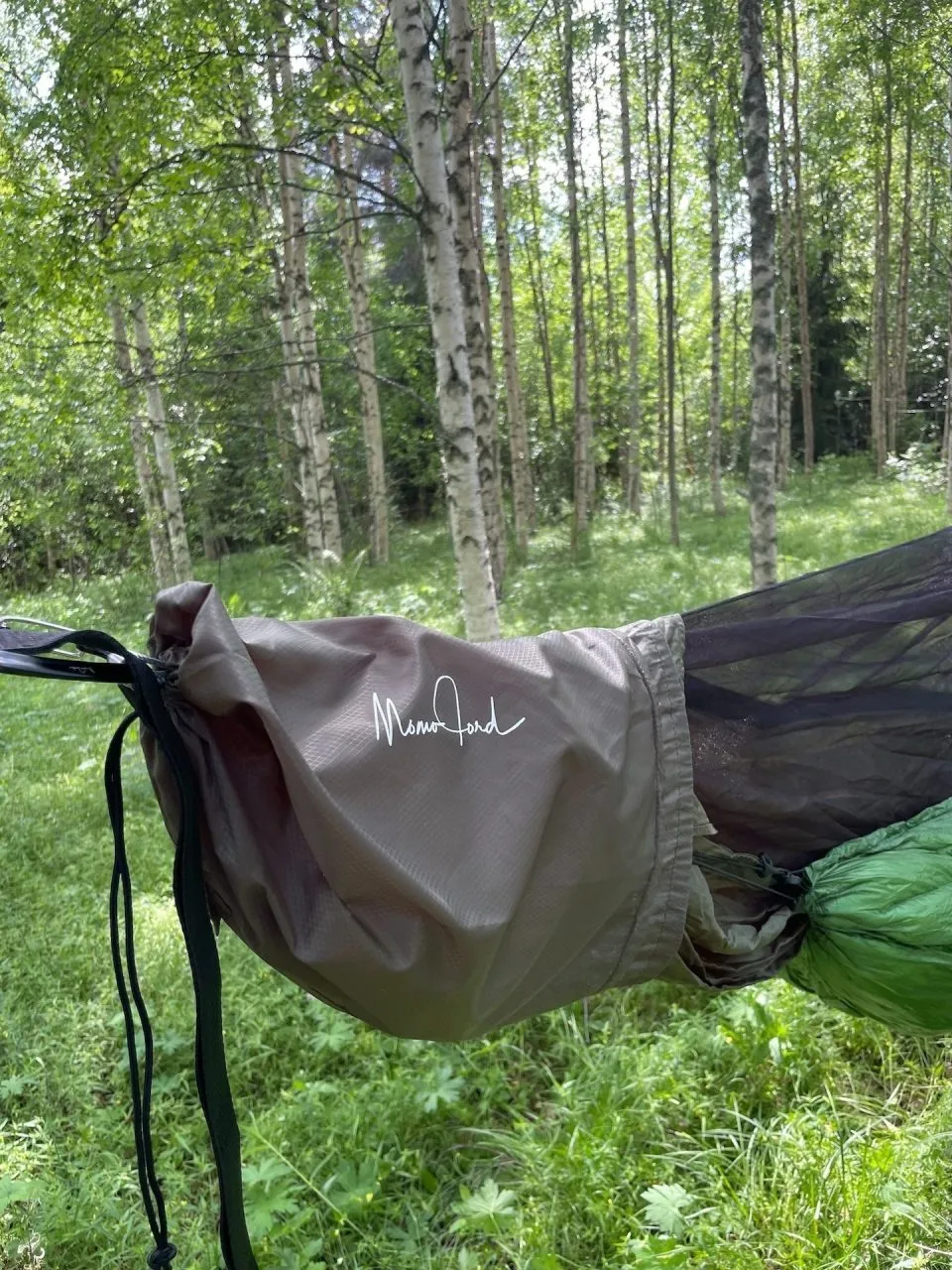
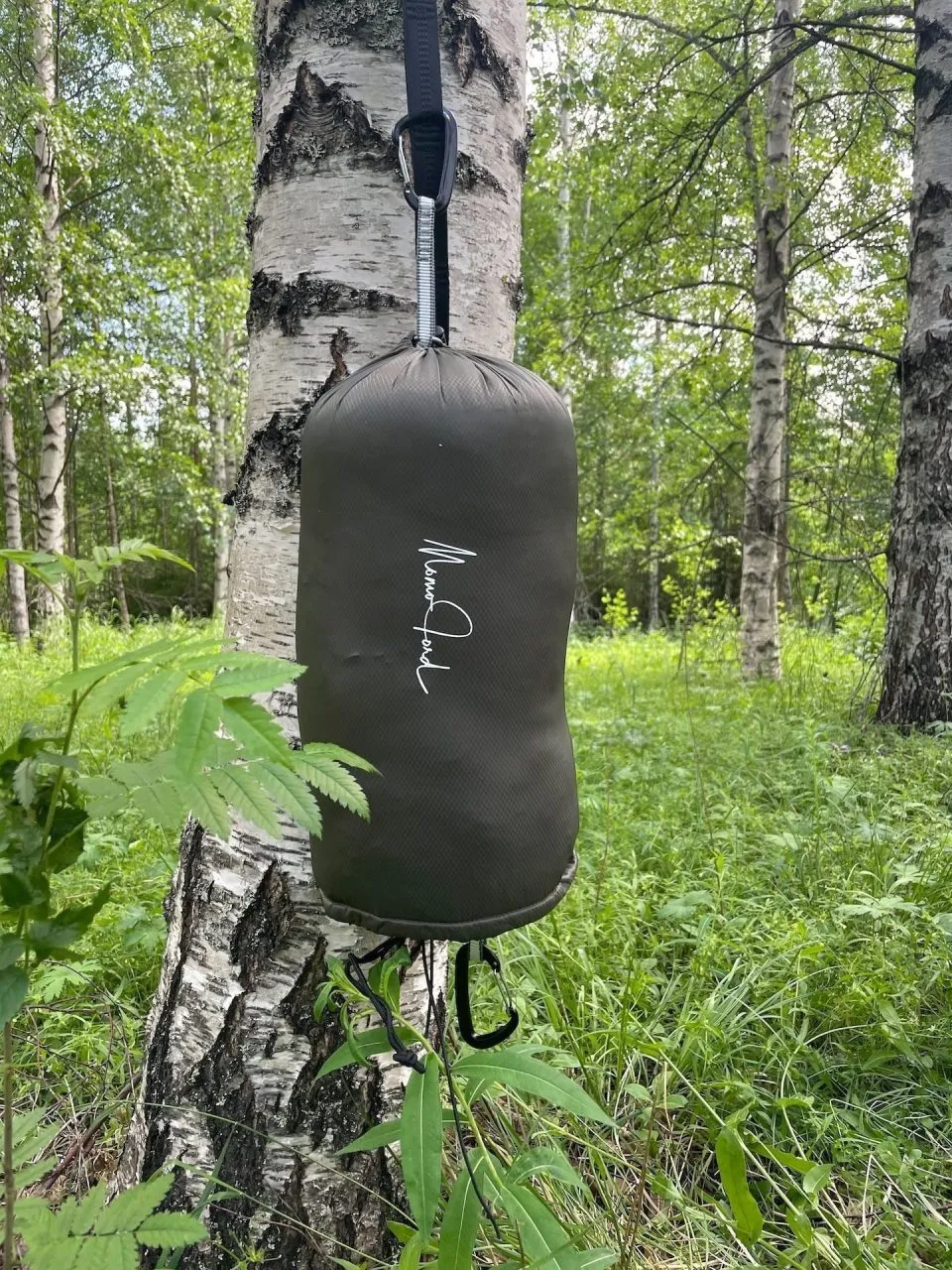
Our route is the asymmetric one. Momo Jord Hammock is 350 cm long and 140 cm wide, cut so you land on the diagonal and the back flattens out properly. Not razor flat like a bridge — I’ll say that plainly — but flat enough for most people, without a bar to assemble. The bug net is built in and midge-proof, the suspension straps and four carabiners are included, and the whole thing weighs 690 g with the net, 1,090 g for the complete system. The fabric is 70D ripstop, PFAS-free, and it holds 150 kg. €159, complete, shipped from Sweden across the EU — free over €250, about a week with DSV, 14 days to send it back. No customs, no forwarder, no waiting on a restock somewhere in Central Europe.
The numbers, side by side
| Momo Jord Hammock | Warbonnet Ridgerunner | |
|---|---|---|
| Price | €159 complete w/ net + suspension | ~€310–350 US import / ~€321 EU stock (hammock only) |
| Type | Asymmetric gathered-end | Bridge (spreader bars) |
| Lying position | Diagonal, flattens out well | Dead flat, like a camp cot |
| Weight | 690 g (hammock + net) / 1,090 g full system | ~1.0–1.4 kg (hammock + net + bars, no tarp) |
| Width at shoulders | 140 cm | 81 cm at centre (112 cm at the ends) |
| Integrated bug net | Yes, midge-proof | Yes on the net build (base “from $130” has none; not fully removable) |
| Capacity | 150 kg | 91 kg single / 113 kg double |
| Suspension included | Yes (straps + 4 carabiners) | Depends where you buy — often extra on a US order |
| Tarp included | No (Asym Tarp sold separately) | No (separate purchase either way) |
| Where to buy | Direct from us, shipped across the EU, no customs | No EU distributor stocks it reliably; one EU reseller (often sold out) or US import |
Prices and specs checked July 2026 with each manufacturer. Competitor prices move — hence the date.
“Isn’t a bridge just better?”
For the flattest possible back? Yes. That’s where the Ridgerunner wins outright, and if that’s the only thing that matters, buy it — look for EU stock first so you don’t eat the import costs on top. But “better” is a fork in the road, not a winner. You pay two to two and a half times as much, carry extra grams, get noticeably less room at the shoulders, and handle warranty claims across an ocean. An asymmetric gathered-end gets you most of the flat back for a fraction of the hassle. Which one’s right depends on whether you’re chasing the last few degrees of flatness or the first night out without a project.
Who should buy what
Buy the Ridgerunner if you’re a back- or side-sleeper who wants an absolutely flat lie, don’t mind tinkering with gear, and can live with the extra weight, the narrower middle and a transatlantic order. If flat sleep matters but importing from the US doesn’t appeal, compare Amok Draumr and Haven Tent first — both ship from EU stock with the customs question already solved. Choose us if you want to hang tonight: light, simple, comfortably asymmetric, net and suspension in one purchase. If you’re curious how we stack up against the rest of the field, there’s the full camping hammock comparison, and if you’re weighing budget over enthusiast gear, DD Hammocks is a more honest opponent on price. One more thing, honestly: our underquilt is cut for a gathered-end, not a bridge — if you already own a Ridgerunner you want a bridge-specific underquilt, and Warbonnet’s own is the obvious choice. How underquilts work regardless of which hammock you sleep in is covered in the underquilt guide.
The verdict
The Ridgerunner lies flatter than we do. That’s true, and it’s the whole point of the thing. But the flattest back in the forest doesn’t help much if the bars are still sitting at home because the parcel got held up at customs. We built one you can hang tonight, for around half the price, with no bars to assemble in the dark.
FAQ
What’s the difference between a bridge hammock and an asymmetric gathered-end?
A bridge uses spreader bars at both ends to hold the fabric open so you lie completely flat, straight along the hammock. An asymmetric gathered-end pulls the ends together and cuts the fabric on the diagonal so you lie corner to corner — nearly as flat, but with no bars, lighter and quicker to rig.
Do you lie flatter in a Warbonnet Ridgerunner?
Yes. A bridge lies flatter than any gathered-end, including ours. The trade-off is more weight (the mandatory spreader bars add roughly 340 g), a narrower middle (81 cm at the shoulders) and a more technical pitch every evening.
What does a Warbonnet Ridgerunner cost within the EU?
No EU distributor stocks it reliably. The one EU reseller with VAT already paid runs around €321, when it’s in stock. Import it directly from the US and, after import VAT, freight and a customs handling fee, it realistically lands around €310–350 for the hammock alone — no tarp included either way. Compare that with Momo Jord Hammock at €159, complete with net and suspension.
Does the Momo Jord underquilt fit a Ridgerunner?
Not well. Our underquilt “Idun” is cut for gathered-end hammocks (Momo Jord, Hennessy, DD, Dutchware). A bridge has a different shape and wants a bridge-specific underquilt — Warbonnet makes its own that fits the Ridgerunner.
Is a bridge hammock good for side sleepers?
For a flat lie, yes. But the Ridgerunner narrows to 81 cm at the shoulders, so broader sleepers can feel pinched. A wider asymmetric hammock like ours (140 cm) gives more room to move if you shift in your sleep.
Want to hang tonight? Asymmetric comfort, net and suspension in one purchase, at €159 — Momo Jord Hammock is here. If the flattest possible back is worth the import, the Ridgerunner is an honest choice; just look for EU stock first so you skip the customs bill.